

Episode 26 | Echoes of History: 1932 Summer Olympics
1932 Summer Olympics
Episode 26
Listen In
Below, you'll find the full transcript of today’s episode, in case you prefer to read or want to reference something we talked about.
Other Places to Listen
About Sabotage Games

Who will pay the ultimate price for Olympic Gold?
LAKE PLACID, N.Y., 1932—Sports journalist Emma Hancock is determined to claim her place in the press box, despite the male colleagues who slam the door in her face. But when a mysterious illness begins systematically sidelining athletes, Emma’s gift for spotting patterns reveals a plot far more sinister than mere competition.
With the Games in his own backyard, Olympic sprinter Ryan Callahan laces up his speed skates to compete in his first winter games. He has no time for distractions—especially not the inconvenience of the beautiful female journalist staying as a guest in his family’s crowded home.
But when the pattern of sabotage deepens, Emma and Ryan must work together to follow the threads before they become the next targets to fall.
La Verità con Integrità. Truth with Integrity. The Legacy of a (Girl) Stunt Reporter.
About Danielle Grandinetti
Danielle Grandinetti writes award-winning 1930s historical romantic mystery, earning the 2026 Holt Medallion. Fueled by tea, books, and nature, she crafts stories exploring immigrant heritage, found family, and cozy Midwest traditions. She lives along Wisconsin’s Lake Michigan shoreline with her husband and two boys. Find her at daniellegrandinetti.com.
Want to Read it Today?
*as an Amazon Affiliate, I earn from qualifying purchases.
Transcript
Welcome to A Spot of Story with Danielle Grandinetti. Cozy up with your favorite beverage as we chat about sweet romance, thrilling suspense, and fascinating history. Perhaps you'll find your next read in one of these stories.
On this episode of Echoes of History, we are diving back into the 1930s to talk about the Summer Olympics. Last month in my Echoes of History episode, I talked about the 1932 Winter Olympics in Lake Placid because they are the primary setting for my book Sabotage Games, a 1930s historical romantic mystery, part of the DiStasio Giornaliste Agency featuring an agency full of female reporters.
My sports reporter, Emma Hancock, traveled to the 1932 Winter Games and uncovered a fictional threat of sabotage. But the story doesn't end there—as the story progresses, she ends up at the Summer Olympics to cover the 1932 LA Games. And I thought this was such a fun little twist to include the LA games because the next Summer Olympics is going to take place in LA.
The 2028 games is the third time that Los Angeles has hosted the Summer Olympics. The first time was in 1932, and that's when the Coliseum that hosts all the things was built for those Summer Games. So it was so fun in the story to be able to include those types of details in the book.
The Winter Olympics was the first year that they used a medal podium, and it was kind of hodgepodge together for the Winter Games. But by the Summer Games, they'd fixed all the mistakes that they made the first time around, so it was numbered and it was more obvious which side was second, silver versus bronze. But track was competed at the Coliseum, and so it was just really fun to be able to include that in my story.
So today for Echoes of History, I want to talk more about the Summer Olympics since last month I talked about the Winter Games. And not just the Summer Olympics, but obviously since this is Echoes of History, more specifically the 1932 Olympics.
The 1932 Summer Games was the 10th Olympiad. The Winter Olympics was the third Winter Olympiad. The Summer Games of 1932 were the 10th Olympiad, so they were still working out what it looks like for the modern Olympic Games.
What made the 1932 games unique, however, was the fact that it happened at the heart of the Great Depression. And that's the thing about the Great Depression—it wasn't just in the US, it was a global depression. So the fact that other countries were in economic hardships meant that the first LA games were much smaller than perhaps the four years before. Four years later, they were in Berlin, so things were a little dicey in those couple of years, which brings me to another part of the Olympics that I found entirely fascinating.
During the 1932 Summer Games, the Germans didn't really want to participate. The speculation is that they didn't want to be shown up by those they considered a lesser race than the Aryan blood. So instead of putting themselves up against people to perhaps fail, they preferred not to enter the competition. That changed in four years, which is part of why Berlin hosted the games—now they were prepared to show that the Aryan bloodline was the superior bloodline athletically.
Gender was a huge aspect in the 1932 Summer Games as well. Female Olympians were not appreciated, we'll put it that way. They were appreciated in that they were considered beautiful and athletic, but there was a general consensus that women should not be athletic in the way that the men were athletic. But if competing in the Olympics made them prettier, better mothers and wives, then people in general were all for it.
So between the racial challenges and then the gender challenges happening in the 1932 Summer Games, it was kind of a fraught Olympiad that year. And then you add economic challenges, all generally speaking made for a very interesting setting.
I don't spend a lot of time in LA in my book because I focused on the Winter Games during the 1932 games. But if you do follow along with my DiStasio Giornaliste Agency series, the heroine of the last book in the series does travel to the Berlin Games. Since I covered the Winter Olympics more in Sabotage Games, when I get to book six, I will spend more time on the Summer Games because of such major events that happened during the Berlin Summer Games, which is a different episode altogether.
For now, just talking about the LA Games.
Another aspect of the 1932 Summer Games that was unique was twofold. First, they shortened the Summer Games so that it was a more focused time as opposed to stretched over weeks or maybe stretching months. Instead, it was just 16 days, and it's been between 15 and 18 days ever since according to the Olympic website.
It's really fascinating. I highly recommend browsing the Olympic website. It's got so much history and so many interesting historical tidbits that if you're a history buff, especially an Olympic history buff, definitely go explore that.
And the other aspect: because they had it shortened, they were able to create the very first Olympic Village. The male athletes were housed in this community they built, whereas in past Olympics, they stayed at hotels or wherever they found housing. But in this particular Olympic, it was the first time there was actually an official Olympic Village. But it was only for the men, and the women were housed in one of the local hotels.
There was one particular Olympic athlete that I found the most intriguing during my research for Sabotage Games, and that athlete was Mildred Ella "Babe" Didrikson. She was an American track and field athlete. But again, at the time, women were not allowed to compete very much, so she could only compete in the three sports allowed to her. In the three sports she participated in, she won gold, gold, and silver. The speculation is that had women actually been able to compete in, say, the pentathlon that is available to them today, she may have won that handily.
She was an all-around incredible athlete, and then she went on to become one of the best female golfers of her time. I love learning about these unique individuals that were ahead of their time. Because of that, we don't remember them as well because they were so innovative and so at the cutting edge of their sport. But they also are athletes that paved the way for the modern success of women today. With that in mind, I love being able to highlight some of these women like Babe Didrikson.
While this is primarily a history podcast, I am looking forward to the 2028 LA games, and I'm hopeful that because the 1932 games were set in LA, perhaps we'll get to see some of this history played out during the opening games in '28. I'm also looking forward to just seeing how the Olympics keep growing, changing, and adapting.
There are always sports, as I talked about last month, that need to have gender equality. There are always ways that we can improve and grow as we show the incredible athleticism that is part of humankind. I'm so glad I got a chance to explore the 1932 Olympics in Sabotage Games, and I hope if you are curious about the Winter Olympics, you'll check out last month's episode.
Otherwise, if you want to read a fictional telling of the 1932 Winter and Summer Games, I hope you'll grab yourself a copy of Sabotage Games, where some of this history that I talked about today will be woven into that story.
Thank you for listening to A Spot of Story with Danielle Grandinetti. We hope you enjoyed today's conversation. Let us know by leaving a comment below, and be sure to subscribe so you don't miss an episode. Discover more information about today's book by visiting A Spot of Story online at daniellegrandinetti.com/podcast.
Happy reading.
To make this story accessible to everyone, an AI-assisted transcript is provided above. It has been edited for clarity to ensure it captures the heart of our conversation.
Share the Tea
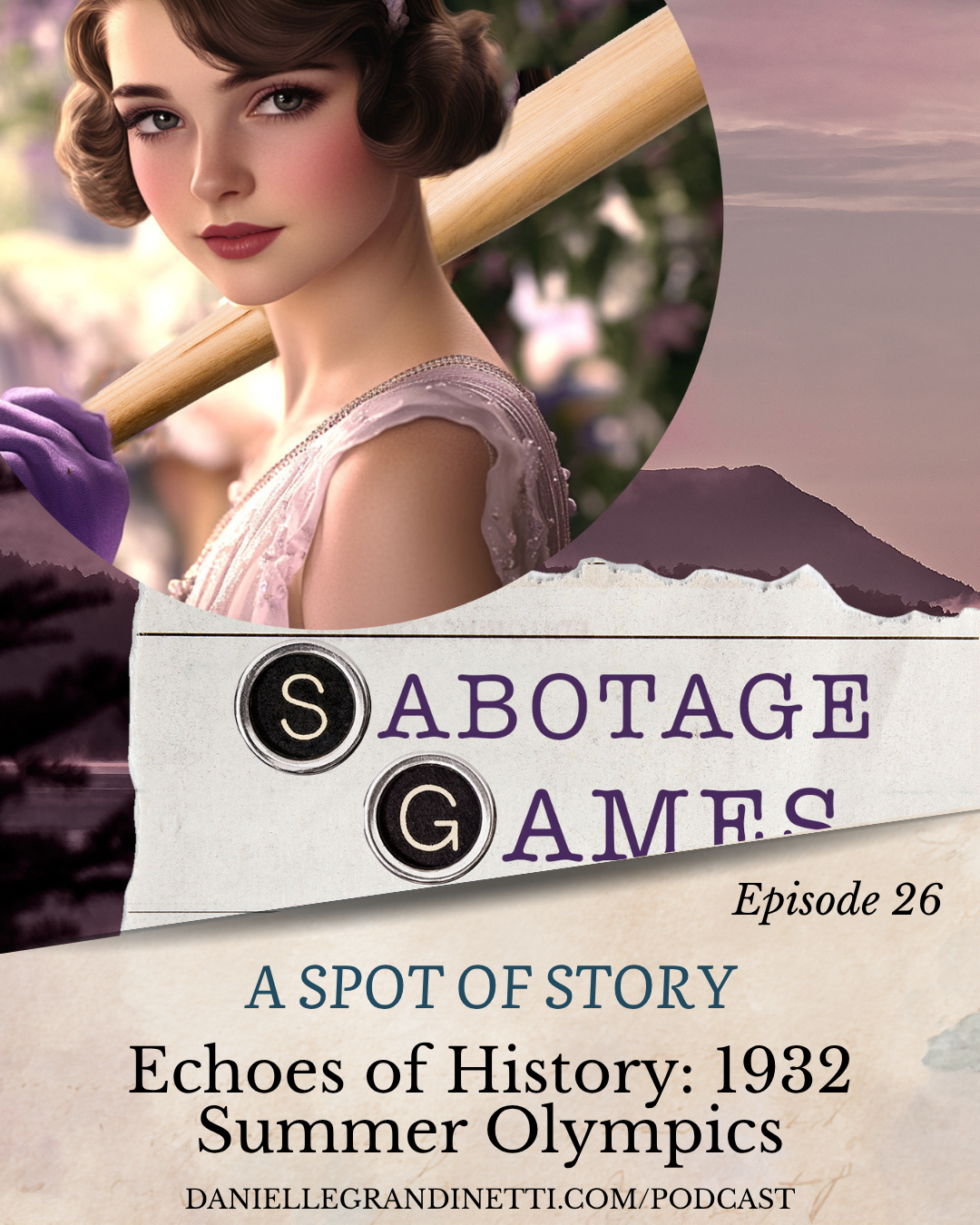
Enjoyed today’s post? You can share it with a friend, pin it to your reading list on Pinterest, or pass it along in your favorite book group. You’re welcome to use this graphic or one of the share buttons below.
I’d love to hear what resonated with you about this book — feel free to leave a comment. I always reply, though if it’s your first time posting I’ll need to approve it before it appears.
And if you’d like to support me and help keep it free, you can always buy me a tea.
Ciao, and thanks for visiting!
The best way to stay connected is through my weekly email, Fireside News. You’ll receive cozy updates, behind-the-scenes book notes, and a complimentary historical romance novelette when you subscribe.
Until next time, may your reading bring both light and encouragement.
Happy reading!
~ Danielle.



0 Comments