

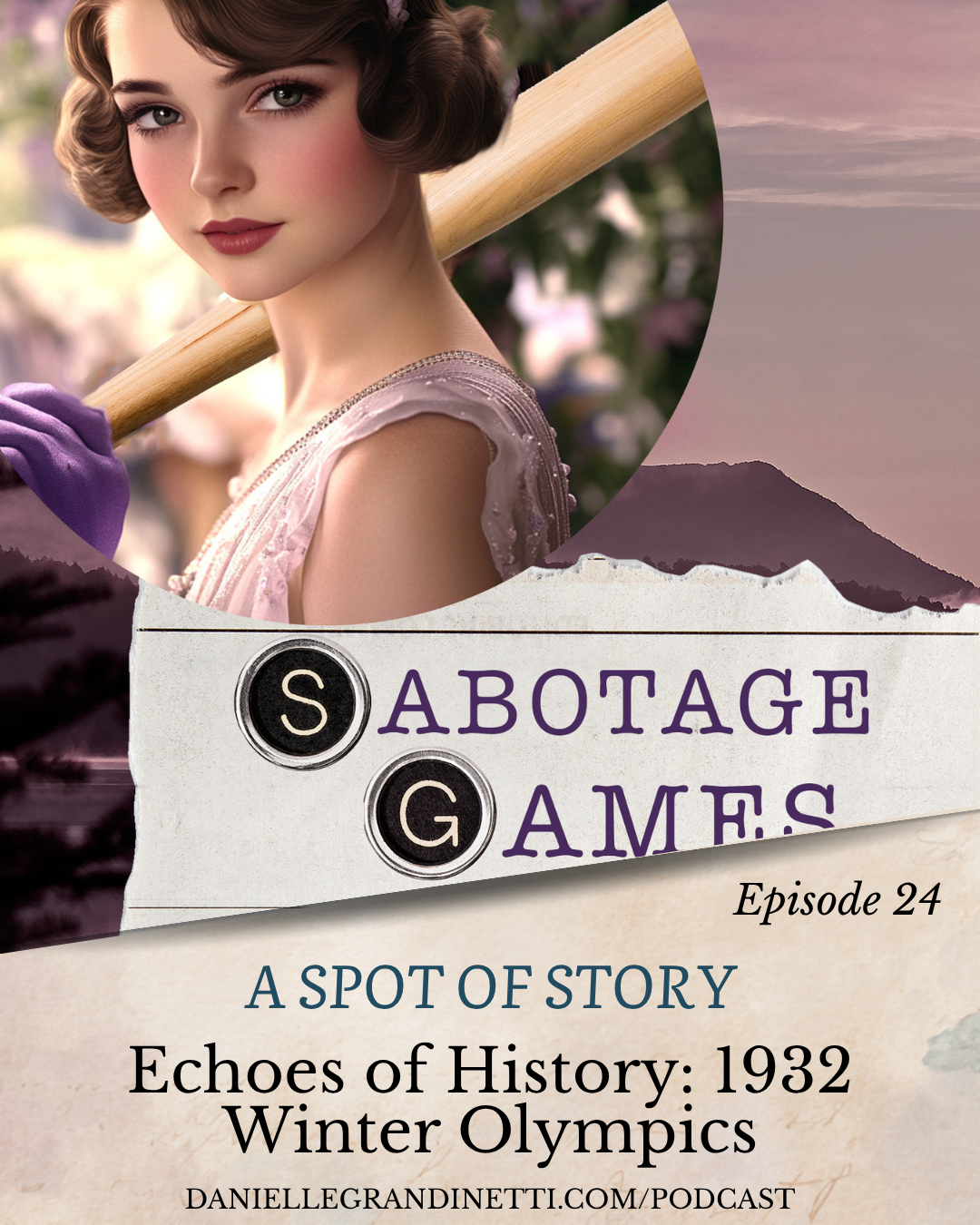
Episode 24 | Echoes of History: 1932 Winter Olympics
1932 Winter Olympics
Episode 24
Listen In
Below, you'll find the full transcript of today’s episode, in case you prefer to read or want to reference something we talked about.
Other Places to Listen
About Sabotage Games

Who will pay the ultimate price for Olympic Gold?
LAKE PLACID, N.Y., 1932—Sports journalist Emma Hancock is determined to claim her place in the press box, despite the male colleagues who slam the door in her face. But when a mysterious illness begins systematically sidelining athletes, Emma’s gift for spotting patterns reveals a plot far more sinister than mere competition.
With the Games in his own backyard, Olympic sprinter Ryan Callahan laces up his speed skates to compete in his first winter games. He has no time for distractions—especially not the inconvenience of the beautiful female journalist staying as a guest in his family’s crowded home.
But when the pattern of sabotage deepens, Emma and Ryan must work together to follow the threads before they become the next targets to fall.
La Verità con Integrità. Truth with Integrity. The Legacy of a (Girl) Stunt Reporter.
About Danielle Grandinetti
Danielle Grandinetti writes award-winning 1930s historical romantic mystery, earning the 2026 Holt Medallion. Fueled by tea, books, and nature, she crafts stories exploring immigrant heritage, found family, and cozy Midwest traditions. She lives along Wisconsin’s Lake Michigan shoreline with her husband and two boys. Find her at daniellegrandinetti.com.
Want to Read it Today?
*as an Amazon Affiliate, I earn from qualifying purchases.
Transcript
Welcome to A Spot of Story with Danielle Grandinetti. Cozy up with your favorite beverage as we chat about sweet romance, thrilling suspense, and fascinating history. Perhaps you'll find your next read in one of these stories.
On this episode of A Spot of Story: Echoes of History, we are traveling back to the 1930s to talk about the Olympics.
In the 1930s, there were two sets of Olympics. There were the 1932 Olympics and the 1936 Olympics. In this episode, we're going to talk about the 1932 Olympics, and specifically the 1932 Winter Olympics. Next month, come back, and we'll talk about the 1932 Summer Olympic Games.
I am an Olympic Games history buff. I am fascinated by how the Olympics have grown and changed since the modern Olympic Games began a little over 100 years ago. It's entirely fascinating how they began with relatively simple sports, such as track (which was called "athletics" at the time), and gradually grew to include more and more sports.
You'll notice, however, that a lot of the sports as they began were all men's sports. Women's sports have struggled to catch up in a lot of areas, which is probably a whole other episode that I could get into, so I won't talk too much about that today. However, it does play into my Olympic Games historical romance.
Sabotage Games follows a female sports reporter who travels to both the Summer and Winter Games, and I do talk a little bit about one of the women's sports that was highlighted during the Winter Games. That particular sport was speed skating.
Speed skating in the 1932 Winter Games was a demonstration sport. It was not actually an official race until, I believe it was the 1950s. So like I said, I probably have to do another episode just on female sports in Olympic history. But for now, we'll just talk about the Winter Games in Lake Placid in 1932.
Diving into the history of Lake Placid and its first time hosting the Winter Games was entirely fascinating.
The hero in my story, I picked speed skating as his sport. Speed skating at the time had two different starting types. One is a mass start, and the other is a timed start. So if you look at our current versions of speed skating, you have short track, which has that mass start where everyone starts at once, and then you have the long track, where you have two racers and they race—a little bit more of a timed, little less chaotic start, shall we say.
Those two different starts represented international rules versus American rules. Because the games were in America, they decided to use the American rules. There were enough countries that did not like that that they boycotted the games. There were a few other reasons for that, but the mass start that they were using in the speed skating meant a lot of the international speed skaters boycotted.
Another aspect of the Winter Games was that it was the first time that a tiered medal stand was used. It was funny: what they did for the platform was basically use hay bales or boxes to set up the different levels. It was basically thrown together. And then the announcer who announced the very first medals of the games—which was one of the speed skating races—accidentally put second place on the third-place spot and got it all mixed up, which was hilarious because there were no numbers. And so even though the rules were laid out and the instructions were written, and he's the one who actually wrote the instructions, he got it mixed up!
So the other aspect of the Winter Games that is fascinating is that Franklin Delano Roosevelt had just tossed his hat in the ring for the presidential campaign. He was Governor of New York at the time, and he came to the opening ceremonies. The opening ceremonies lasted half an hour, and then immediately went into a speed skating race, then they played hockey on the same ice rink, and then they had another speed skating race. It was just this whole big afternoon event.
However, the Olympic Games almost didn't happen that year because of the snow—or should I say, the lack of snow. Being outside and being winter sports, they were entirely dependent on the weather, and that year the weather did not cooperate until the night before the opening games when there was a blizzard. I believe a person or two might have died during that blizzard. It's one of those where it's like, "No, we wanted snow to gradually form a nice, cold, hard ice base, not have it all dump all at once." That is not what happened, to the point where throughout the games the ice kept melting, so they had to move several of the events to the inside arena, which is where the figure skating happened.
The figure skating I didn't dive into in my book very much, but there is quite a bit of history with the female figure skaters at the time. I would highly recommend—and I'll see if I can find the video again on YouTube so I can link it in my show notes—an actual recording of some of the highlights of the Winter Games. I found the ice skating part on the "misogynistically fascinating" side, if I can say it that way. You had these men basically critiquing these women as they did single spins on the ice, and they were standing a little close. It was just kind of awkward and odd, and yet this was the beginning of ice skating as a sport.
There was quite a bit of misogyny and racism all wrapped up in the Olympics at the time. The bobsled run was placed on the Lake Placid Club land, but they almost lost the bid because the rules of the Lake Placid Club prohibited both Jewish members and Black members at the time. And so the racism and anti-Semitic laws almost denied Lake Placid the Olympic bid because of this.
The Lake Placid Club was owned by the Deweys. You might know Melvil Dewey as the founder of the Dewey Decimal System and former state librarian in New York, who was removed because of sexual harassment toward the female librarians around him. He was overall not a good man, and there is a lot of history to back up that particular claim—it's actually well-known within library science, and yet we use the Dewey Decimal System to this day.
He founded the Lake Placid Club, and his son, Godfrey Dewey, was actually the one operating it at the time. He was also highly involved in bringing the Winter Games to Lake Placid. And so they were able to work out a deal where the Lake Placid Club got no financial ramifications of having the bobsled run on their land in perpetuity—like if they ever sell the land, it's held in trust so that Lake Placid Club gets no benefit from the Olympic Committee using the land that they basically donated because of those bylaws in place at the time.
There's more to the anti-Semitic situation happening, but it tends to play a little bit more into the Summer Games, so we'll talk about that next time. But around all of this drama built around the 1932 Olympics, there were a couple of really key moments.
As I mentioned at the beginning, one of the biggest events over the course of the Olympics was the speed skating records. An American, Jack Shea, is the man who won as the fastest speed skater. On the women's side, the fastest female speed skater was Jean Wilson. She not only won the 500-meter speed skating final, but her record was actually faster than the world record held by an Australian. She actually broke that record, but it is not recorded because it was an exhibition game, so it wasn't an official race.
I'm so glad that I chose to have a female sports reporter, because the dark areas around the Olympic Games—there were quite a few, and I think making sure that we don't forget those things is really important. Especially because there are still women's sports within...
Okay, I'm obviously going there right now because I can't wait for another month to talk about women's sports! There are still women's sports in the Olympic Games that are still exhibitions, that are still not considered official Winter Games, even though they have a men's sport.
One of the prime examples is the Nordic combined. It is only for the men. That is a combination of ski jumping and cross-country skiing, and at the moment, they deny the women entry. There's no women's Nordic combined—it's only for the men. And it is the only Olympic sport that doesn't allow women to compete. Like speed skating was 100 years ago, where it was only for the men and took years for the women to get it officially approved, Nordic combined is up against the same regulations, and they're trying to change that. Again, here we are 100 years later.
So that's one of the things that I love about diving into Olympic history. We can see how far we've come, but we're still not there yet. There's still so much to go in the Winter Olympics and making sure that both men and women have a fair chance to compete.
At the time, the Winter Olympics and Summer Olympics were held in the same year and often in the same country. It was combined, and then after World War II is when they split to every other cycle. The 1932 Olympics is considered the third Winter Olympiad.
Most of my book, Sabotage Games, is set in Lake Placid. I do dive a little bit into the Summer Olympics in that book, and I'll talk more about the Summer Olympic Games next month.
Thank you again for joining me today on Echoes of History as we dive back into the 1932 Winter Olympic Games.
Thank you for listening to A Spot of Story with Danielle Grandinetti. We hope you enjoyed today's conversation. Let us know by leaving a comment below, and be sure to subscribe so you don't miss an episode. Discover more information about today's book by visiting A Spot of Story online at
Happy reading.
To make this story accessible to everyone, an AI-assisted transcript is provided above. It has been edited for clarity to ensure it captures the heart of our conversation.
Share the Tea
Enjoyed today’s post? You can share it with a friend, pin it to your reading list on Pinterest, or pass it along in your favorite book group. You’re welcome to use this graphic or one of the share buttons below.
I’d love to hear what resonated with you about this book — feel free to leave a comment. I always reply, though if it’s your first time posting I’ll need to approve it before it appears.
And if you’d like to support me and help keep it free, you can always buy me a tea.
Ciao, and thanks for visiting!
The best way to stay connected is through my weekly email, Fireside News. You’ll receive cozy updates, behind-the-scenes book notes, and a complimentary historical romance novelette when you subscribe.
Until next time, may your reading bring both light and encouragement.
Happy reading!
~ Danielle.



0 Comments