Episode 18 | Echoes of History: Origins of the Great Depression
Origins of the Great Depression
Episode 18
Listen In
Below, you'll find the full transcript of today’s episode, in case you prefer to read or want to reference something we talked about.
About Shipwrecked Faith

Chicago, October 1929—Kellan O’Roark is running on borrowed time. After handing over his cousin’s incriminating bootlegging ledger to the police, he intends to vanish before the mobster exacts revenge. His destination: the SS Wisconsin, a steamer headed for Milwaukee, upon which he’s secured work despite his fear of the water.
But despite his pressing need for escape, Kellan faces obstacles while leaving Chicago—including one who may break open his heart. Sadie Dawning, desperate to return to her family’s Wisconsin farm and ailing father, escapes a kidnapping attempt at Chicago Union Station when Kellan steps in and offers to smuggle her aboard the Wisconsin. His decision turns nearly fatal when an autumn storm capsizes the ship.
Washed ashore, the pair arrive at Sadie’s family farm to find new storms brewing on land. While Kellan hides his past to continue evading his cousin, Sadie fights for her place among her sisters while the farm battles the beginnings of the Great Depression. Caught between duty, a dangerous past, and a budding love, Kellan and Sadie must rely on their newfound faith in each other and renewed faith in God to weather the growing storm.
About Danielle Grandinetti
Danielle Grandinetti writes award-winning 1930s historical romance filled with mystery, suspense, and hope. She is a second-generation Italian-American rooted in Midwest traditions. Fueled by tea, books, and the creative beauty of nature, her stories explore love and belonging in hard times. Find her online at daniellegrandinetti.com.
Want to Read it Today?
*as an Amazon Affiliate, I earn from qualifying purchases.
Transcript
Welcome to A Spot of Story with Danielle Grandinetti. Cozy up with your favorite beverage as we chat about sweet romance, thrilling suspense, and fascinating history. Perhaps you'll find your next read in one of these stories.
On this episode of A Spot of Story: Echoes of History, we are stepping back into the 1930s to explore the very beginning of the Great Depression.
October 29, 1929, is known as Black Tuesday. This is the day that the stock market crashed and what we now know as the Great Depression began. However, it was actually not a single event that caused the crash. I feel like with history, we like to pin it all on one date, but the Great Depression was actually a buildup of what happened post-World War I.
After the war, as everyone found their footing again, the foundation had been shaken enough that the opulence of the 1920s was built on very shaky ground. On top of that, there were multiple weather situations that were happening in the United States. While we think of it as a very US event, the Great Depression was global; it was a ramification of World War I. It was a global economic depression that affected multiple countries. But the US suffered quite greatly—one, because of the industrial nature of the country at the time, but two, because of the weather.
We have to back up a little bit to understand what caused the downturn and how the weather affected it by understanding a little bit about farming. As the Western expansion changed the landscape of the prairies, and as more and more people decided to begin homesteading and farming in the Great Plains, they killed off the buffalo. There were no animals to actually tamp down the soil in the prairie region. Not only that, they ended up tearing up all the grasses that anchored the soil to the ground and instead planted wheat and corn and crops that required a lot of moisture to grow. Which at first worked out wonderfully, and it turned out to be a great place to have your homestead and your farm.
But in the 1920s, the weather systems created a drought—and I can't remember if it was an El Niño, but it was that type of weather event—where there were multiple years of dry weather. And so it dried out the soil, and because they didn't necessarily understand crop rotation at the time and proper soil management (that concept came out of the Great Depression to keep it from happening again), the soil began eroding and became what we also know as the Dust Bowl. It started affecting crop prices, and as crop prices went down, the farmers started having a harder time, which means they in turn couldn't provide the food the nation needed. So it was this multifaceted building of problems that ended up creating this crash.
We're going to add to that, that post-World War I, the men had all gone to war, and so women—after the 19th Amendment—began taking jobs. As the men came back, the women had filled in the gaps while the men were at war. And so now, entering the 1920s and 1930s, there was also a gender clash of, "The women took all our jobs. Now what do the men do? We need more work. We need more jobs. Women need to leave the workplace."
There weren't enough jobs to fill then because the entire system had changed, again, because of the war. Somebody still had to work and keep the home front while the men were fighting. So the women had naturally stepped in, and they were good at their jobs and capable. They didn't want to give up the life that they had built to care for their family, or in the case of war widows, they were the only thing standing between their children and poverty. It gave an opportunity for unmarried women to actually hold down a job and be independent. So not only was there a cultural change at the very familial level, it also impacted the employment rate.
So you have weather, you have the employment rate, and now you have the financial side. Think about the late 1800s and the Gilded Age era where the wealthy were opulent and looked very wealthy, whereas the disparity between those who were poor was very, very great. In the 1920s, it leveled out a bit, I think, where everybody portrayed that wealth whether they had it or not. The war was horrible and awful and everyone just needed to let loose. You have the Jazz Age, you have the speakeasies, because again, they come back from war and no, you may not have alcohol—but you can if you go find it illegall
All of these things are combining into this perfect storm so that in October, as things on the stock market start getting a little rocky, the bubble bursts. And that is actually what happens on the 29th. But again, it didn't happen all at once. There's actually a few "black days," all at the end of October. So the stock market collapse actually began on Black Thursday, which was the 24th of October. There was a steep drop and they thought they'd fixed it. But then Black Monday, the stock markets crashed again. And so by the time Black Tuesday hit, it had been a week of failure after failure after failure. They just couldn't recover then, and so people lost everything.
But it wasn't the global news that it is now. Instead, they got their news from the newspaper, and they heard about this event that happens on Wall Street. The wealthy patrons are the ones who buy stocks and have them on Wall Street—the business owners, the conglomerate heads, the ones with all the money who then lost it because they bet on the stock market. But the banks also got their money from the stock market, and at the time there was no insurance. So you put your money in the bank, the bank uses the money, they lost the money on the stock market, and now the everyday people can't get it back because there is no money. The bank failed; they lost all their money.
So you have business owners who lost their money, so they can't keep their companies and end up having to lay off employees—and they laid off women first because of all the gender challenges that had been going on. You have banks who lost their money, and so they can't give the layperson their money back. So now the everyday person is out of money. They just got laid off from their job. There's no money left.
It was a buildup of a spiral that happened to lead up to the Great Depression, and then triggering the Great Depression was several factors all at once that just imploded. And the Dust Bowl aspect is part of what made the Great Depression more impactful here in America because you added on this climate aspect, so our food supply was affected as well. So a lot of factors played into what made it such a difficult decade.
One of the reasons why some of FDR's policies actually helped pull them out was because they were doing studies on crop rotation. He began the Conservation Corps to replant trees that the lumber mills had decimated. He started farming compensation and programs to be able to help farmers recover. And so getting some of those programs started was one of the things that helped give the country a leg up to right itself.
And from a big picture, once World War II began in Europe and the US entered it, that's a whole other layer we aren't going to get into. In a lot of ways, World War I opened the door for World War II. The interwar period was more of a ceasefire than it was an actual end to the war, even though it was very much touted as that. You know, "the Great War is the war to end all wars." You have Armistice Day, a day where there's a ceasefire and everything stopped at the 11th hour of the 11th day of the 11th month.
No one really saw World War II coming. I wouldn't say nobody; there were definitely people who saw it coming. But there was this general feeling that, "Nope, the war's over. That's good. Let's celebrate." But they never actually fixed the problems that caused World War I. So now you had the economic side of things that ended up bringing about a vacuum that created the door for World War II.
Why do I talk about all of this and how Black Tuesday, the day the stock market crashed, was the start of the Great Depression? Because I have a book that actually takes place on that particular day, on October 29. And what made it most fascinating to me were the headlines. Where most of the country talked about the stock market failing, in Wisconsin, that wasn't the headline. The headline was about the SS Wisconsin, which had left port on the night of the 28th. It was a freight steamer, and it was headed north and ran into a storm.
Now, there had been multiple storms that week. Another ship had sunk about a week earlier. But the captain of the Wisconsin thought they could make it, and they ended up capsizing about five miles offshore, near the Kenosha area. The Coast Guard was sent out. Another fishing vessel braved the incredibly high waves to make it out there to try to rescue as much of the crew as they could.
The newspaper headlines on the 29th and the 30th and 31st weren't about the stock market crash. They were about this ship sinking and about the brave men of the Coast Guard who went out to rescue them. And it struck me so much about how there's this countrywide
And yet, on that day in Wisconsin, their event was a shipwreck. There were lives lost. I listened to a testimony of someone who remembers watching it sink. That was the memory that they took away from that day. Seeing that and learning that is what inspired me to write a story that began on October 29th, 1929. And yes, it was the start of the Great Depression, but in my characters' lives, it was the sinking of the SS Wisconsin.
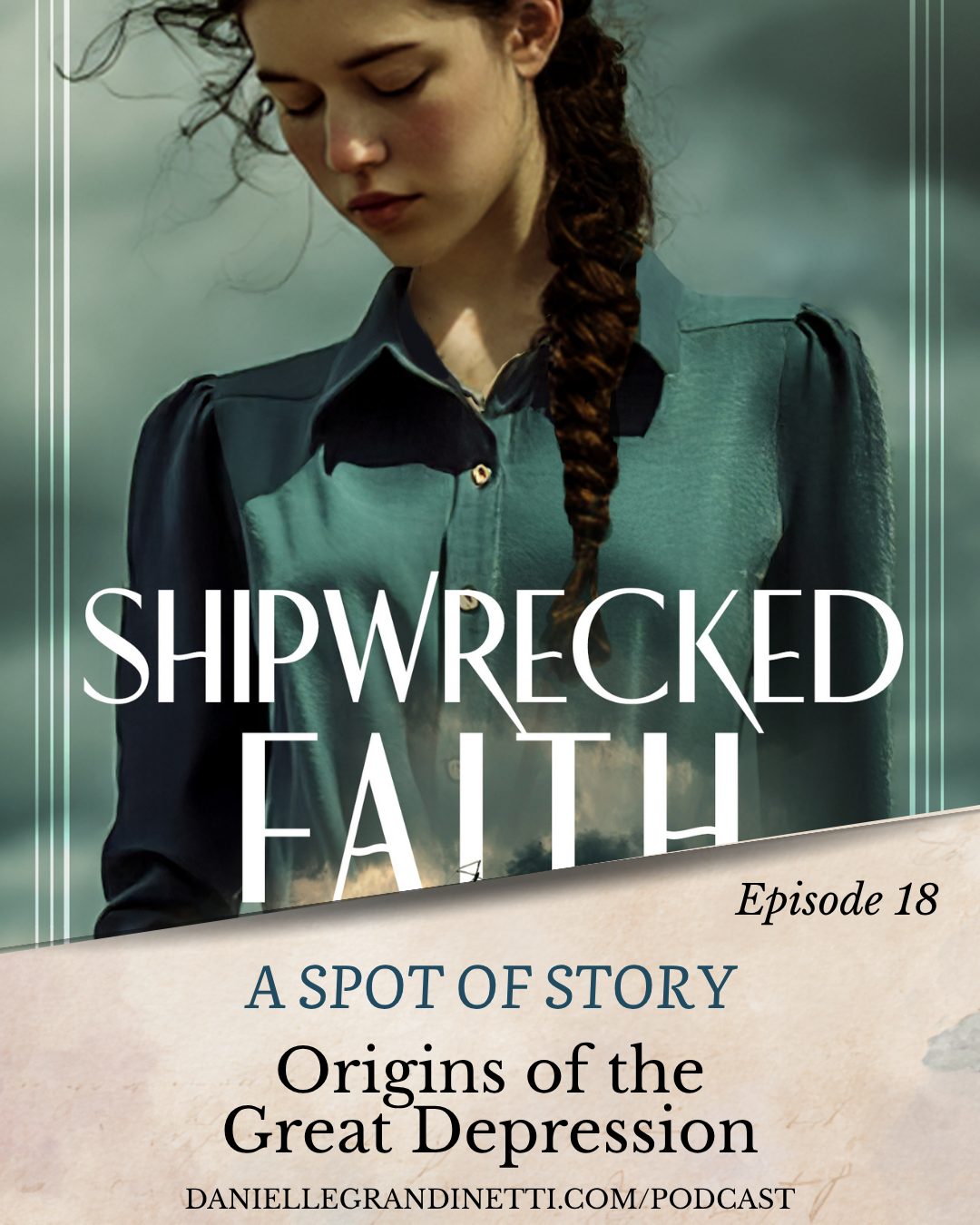
If you'd like to learn more about my book, which is called Shipwrecked Faith, you can visit the show notes, and I'll link to it there. It's a story about an Irish immigrant who has relatives in the Irish mob and wants to get away from all of that, and a farmer's daughter who was trying to work in Chicago when her father falls sick and she needs to get home. Events conspire to put them together on the SS Wisconsin on the day that it sinks, and the story goes from there.
Thank you for tuning in to this journey into the past. Again, you can find additional resources in the show notes and links to Shipwrecked Faith on the episode page. I hope you enjoyed this little peek into the past.
Thank you for listening to A Spot of Story with Danielle Grandinetti. We hope you enjoy today's conversation. Let us know by leaving a comment below and be sure to subscribe so you don't miss an episode. Discover more information about today's book by visiting A Spot of Story onlin
Happy reading.
To make this story accessible to everyone, an AI-assisted transcript is provided above. It has been edited for clarity to ensure it captures the heart of our conversation.
Share the Tea
Enjoyed today’s post? You can share it with a friend, pin it to your reading list on Pinterest, or pass it along in your favorite book group. You’re welcome to use this graphic or one of the share buttons below.
I’d love to hear what resonated with you about this book — feel free to leave a comment. I always reply, though if it’s your first time posting I’ll need to approve it before it appears.
And if you’d like to support me and help keep it free, you can always buy me a tea.
Ciao, and thanks for visiting!
The best way to stay connected is through my weekly email, Fireside News. You’ll receive cozy updates, behind-the-scenes book notes, and a complimentary historical romance novelette when you subscribe.
Until next time, may your reading bring both light and encouragement.
Happy reading!
~ Danielle.



0 Comments