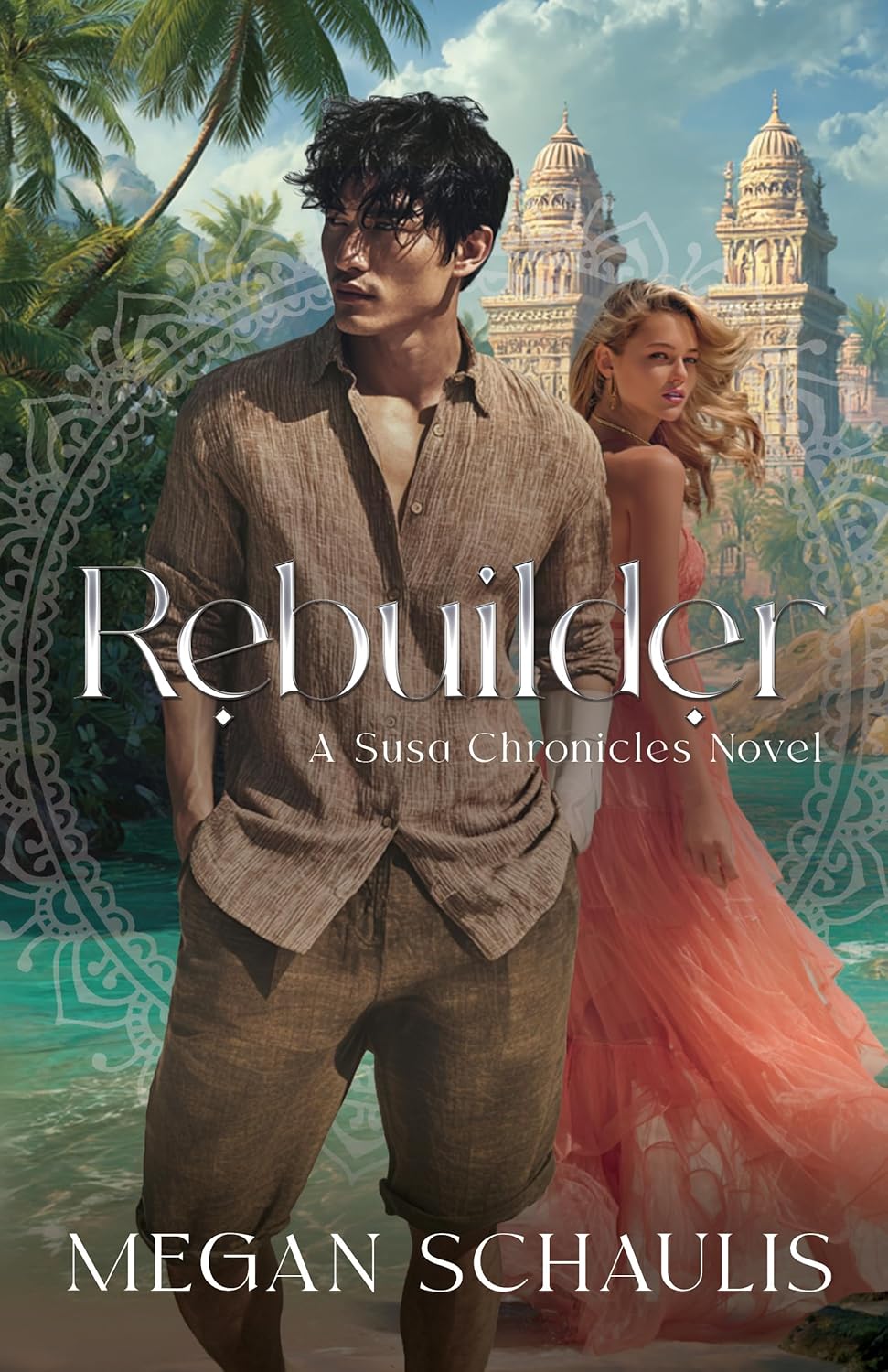
A Spot of Story Episode 17 | Behind the Book: Rebuilder with Megan Schaulis

A Spot of Story Episode 17 | Behind the Book: Rebuilder with Megan Schaulis

Behind the Book

by Danielle Grandinetti | May 2, 2026 | 0 comments

Rebuilder with Megan Schaulis

Episode 17

Listen In

Below, you'll find the full transcript of today’s episode, in case you prefer to read or want to reference something we talked about.

About Rebuilder

Bitter and broken from his imprisonment in the Citadel, Hatch can’t stand to watch the woman he loves start her new life. When the king offers him a position as the governor of Evania, an island territory populated by Alphanites, Hatch sees the job as a chance to escape his heartache. But from the moment his crutches hit the sand of this tropical island, Hatch is deemed an outsider, particularly by Myah, an artsy adrenaline junkie the locals have nicknamed “Princess.”

Myah is content to spend her days writing letters to her far-off fiancé. The last thing she needs is a government official taking over Evania and poking at old wounds. But when an enemy attack causes the island to start sinking into the sea, Myah must convince the sullen governor that her home is worth saving.

With only fifty-two days to stabilize the island, Hatch and Myah must confront the pasts they both long to leave behind. As the ground literally sinks beneath them, will they drown in their regrets or ride the waves of change to a future neither could’ve imagined?

About Megan Schaulis

After a year of traveling the country in a 100-square-foot camper with her husband, daughter, and dog, Megan Schaulis was bursting with wonder and inspiration—and she poured it all into her writing. Megan’s debut novel, Protector, won the 2025 ACFW Carol Award, and was a Christy Award finalist and Realm Award double finalist. Megan lives in Abilene, where you’ll find her homeschooling or staying up way too late reading.

Want to Read it Today?

*as an Amazon Affiliate, I earn from qualifying purchases.


Transcript

Danielle Grandinetti: On this episode of A Spot of Story, I am chatting with Megan Schaulis, author of Rebuilder, the third book in the Susa Chronicles. Megan, welcome.

Megan Schaulis: Hi, Danielle. I'm so glad to be here with you.

Danielle Grandinetti: After a year of traveling the country in a hundred square foot camper with her husband, daughter, and dog, Megan Schaulis was bursting with wonder and inspiration, and she poured it all into her writing. Megan's debut novel, Protector, won the 2025 ACFW Carol Award and was a Christie Award finalist and a Realm Award double finalist. Megan lives in Abilene where you'll find her homeschooling or staying up way too late reading—and that is very, very relatable.

Megan Schaulis: Yes, indeed.

Danielle Grandinetti: So we are talking about Rebuilder. Can you tell me—since the genre is a little bit off of what we might usually read here on the podcast—can you give me just a little summary of what it's about?

Megan Schaulis: Rebuilder is a standalone sequel to my series, The Susa Chronicles, which means it's starring a character from the other books, but it's a totally new setting, totally new cast, and new problems. It makes perfect sense even if you haven't read any of the other books.

In Rebuilder, our main character is a hero who's a bit broken, both physically and emotionally. He's been through some rough stuff and he's given a second chance, a new life, as the governor of an island territory called Evania. From the moment he hits the sand with his crutches in tow, he realizes this might not be the second chance in paradise that he thought he was signing up for. Sure enough, within 24 hours of his arrival, the island itself starts sinking into the ocean.

So he is bringing all of his past into this new life and trying to figure out how he fits in, how he's supposed to lead people that he never intended to lead, and how he's going to solve all of these very real problems. Of course, in the meantime, he meets an amazing young woman who is the daughter of the former leader of this territory, who is very disappointed that he showed up. There's all kinds of fun sparks between them,some swimming with dolphins, ocean adventures, time on the beach, and some very big, high-stakes problems to solve while they're at it.

Danielle Grandinetti: That's wonderful. That sounds like a lot of fun.

Megan Schaulis: Thank you.

Danielle Grandinetti: Well, before we go into what a day in the life of your characters looks like, I want to back up to the spending too much time reading and not getting enough sleep. What are you currently reading?

Megan Schaulis: I just started The Raven by Carrie Cotton [affiliate]. The Raven is the third book in the Huntress series. The Huntress has been all over the place all of a sudden. It came out a few years ago, but in the last year or so, I've seen it pop up in all my Christian circles. This is a wonderful medieval series. You might call it fantasy only because it's a slightly made-up location, but it's not fantastical at all.

It's a medieval series with Scots and Picts and Vikings and really powerful Christian themes. They are beautiful stories of how people heal through all kinds of circumstances set in just the richest historical setting I've ever read. If someone has ever heard of Outlander but didn't want to go there in terms of the content, this is the best possible alternative. So I'm on book three, which is called The Raven.

Danielle Grandinetti: That sounds like a wonderful trilogy. I will link that in the blog post show notes so others know exactly where to go for it. Let's head back to your book. What does a day in the life of your characters look like?

Megan Schaulis: Rebuilder has two main characters. Hatch is the crossover character from the other series. A day in his life starts with taking a walk on his crutches from the sandcastle-like governor's mansion where he lives and heading up the mountain on the island so that he can watch the sunrise. Due to some traumatic events that happened to him in the previous books, he does not start a day without taking time to just breathe and be in the presence of Alpha. Alpha is the name that I give to our God in my series, and that's how he starts his day.

Then he goes and hobbles over to a hot spring where he does some morning hot spring aerobics with some sweet little old ladies while he works on rehabbing. He has his quiet time to watch the sunrise and then his hot spring water aerobics. Then he usually gets some kind of threat or letter from an enemy territory who's determined to sink them. About that time of day, he normally gets a telegram with some bad news and he talks to the few allies he has, which include a very eccentric old inventor and a kind of reluctant friend, surfer dude. They try to strategize how they're going to keep their island from sinking into the ocean in the next three to four weeks. That's how Hatch spends his days.

Myah is the other main character in this story. Myah's nicknamed "Princess" because she was the daughter of the previous governor and she's kind of the island's favorite daughter. They all love her; they all consider her their own. Myah spends a good part of her day in her glass-blowing studio. She is a glass artist and she uses very old-world techniques of glass mixed with fun, imaginary high-tech to create all kinds of things. So she spends a good part of her day sweating it out in the glass studio.

Then she probably does something to get her adrenaline going, like cliff jumping,swimming way too far out in the ocean, or rock climbing. I'm sure she would rather just end her day lying on the beach, counting the stars, maybe drifting off there in the sand and then making her way back home at some point.

Danielle Grandinetti: Oh, that's really fun. I love the glass-blowing part.

Megan Schaulis: Yes. That was one of my favorite things to get to include.

Danielle Grandinetti: Probably talk more about that here in a minute. But first, let's talk about your favorite scene to write in this particular book and why.

Megan Schaulis: This is very hard to do without spoilers. There's a scene early in the story where it is Hatch's very first day on the island. Nothing has gone too catastrophically wrong, but nothing's gone very right either. Myah also has had a rough day; she just found out this guy is supposed to be the new governor—the replacement for her dad. He's moving into her castle and all these things. Nothing went right in the glass studio that day, so she comes into the kitchen of their shared palace and she is just fit to be tied.

She finds Hatch there on his crutches, cooking dinner, and she just tells him every thought that pops into her head about him showing up on her island. She's not censored about that at all and is trying to explain to him how to cook fish and talking down to him. Meanwhile, he is just totally chill. He is completely calm, hopping around on his crutches and trying to figure out what all these tropical fruits are that he's never seen before because he lived in Susa until now.

He is cooking all this food and at the end of the argument, he gets everything cooked and plated up. He slides the plate across the counter and starts to leave, and she says something to him about giving up or walking away. He tells her, "I ate an hour ago the whole time I was cooking for you." I love that scene so much because it's a very early turning point for Myah—seeing how truly good this guy is. What do you do when someone that you were so ready to hate not only tolerates your tirade, but makes you dinner while you're chewing him out?

I love that Hatch is so good. He is such a good guy. That scene encapsulates it so perfectly and it was fun to get to write cooking. I think cooking is great; you don't get to see a lot of fun everyday life cooking scenes in dystopian fiction. It was delightful to incorporate real-life recipes.

Danielle Grandinetti: I love those moments when the hero’s character is laid out right there in front of her. So what research was required to write this story?

Megan Schaulis: Technically this book is dystopian, or very light sci-fi—not a space epic, but some fun non-realistic technology. Most of the research really went into two things: the location and the glass blowing.

Glass blowing is the coolest art ever. I'm fascinated by this process that takes sand—silica and other elements—and heats them up with metals and natural parts of our earth. Then you just breathe into it through a tube and create the most amazing things. I've watched it live, and it's amazing. I followed some competition TV series on glass blowing a while back, so I was trying to remember all the terminology and looking up things related to that, while keeping it at a level where anyone reading it would understand. I'm not using so much jargon that you need an internship in glass blowing to understand the book. I also found out some amazing things about the history of glass blowing, a lot of which didn't make it into the book, but they were fascinating.

The second really fun thing was the location. While this takes place in a fictitious island territory called Evania, I like to base my settings on real places. The first two books take place in a fictitious kingdom called Susa, located in modern-day Iran a couple hundred years in the future. For this one, I based it on the real-life island nation of the Maldives in the Indian Ocean. I found out ridiculous things, like the Maldives being the flattest country on the planet—I think 20 feet above sea level is the highest point. I learned that the government once held an underwater cabinet meeting in scuba gear! Learning about what grows there helped me ground the story in reality, keep track of where the sun should be, and determine the tides.

Danielle Grandinetti: I especially love location inspiration. You're right about glass blowing; I got to see it in person when I was visiting Italy years ago. It’s like magic the way they turn molten sand into something gorgeous.

Megan Schaulis: We had an exhibit at a recent county fair and I basically said to my family, "Have fun at the fair; I'm going to be camped out here watching these guys as long as I can stand it."

Danielle Grandinetti: What is one bit of research you wish you could have included?

Megan Schaulis: Speaking of glass blowing, a lot of us have heard of Venetian glass. That was the heyday of glass during the Renaissance. Venice and the island of Murano were basically glass houses—meaning glass-making companies. They were so secretive about their techniques and formulas that they forbade their glass artists to marry. They thought they would end up divulging secrets or that a competitor would send in a woman as a spy. I don't write historical fiction, but for those of you who do, someone has to write this book about a glass artist who was forbidden to marry in order to protect his trade secrets.

That didn't have a reason to show up in my future-set retelling of Nehemiah, but I was just like, "This is the coolest piece of information."

Danielle Grandinetti: I didn't know that part of history! The glass-blowing workshop I went to was actually on Murano, but I don't remember that part. Yes, that does need to be a story.

Megan Schaulis: I'm not sure how well it was enforced or how well you could manage to keep a secret out of someone—I mean, look at Samson and Delilah. Maybe my next book will be a Samson and Delilah meets Venetian glass artist story on the Island of Murano.

Danielle Grandinetti: I would read that.

Megan Schaulis: I would too if someone else would write it.

Danielle Grandinetti: Alright, well what was the inspiration behind this story?

Megan Schaulis: I do write stories that are inspired by true accounts from the Bible. My first duology, the beginning of the Susa Chronicles, is a two-book series inspired by Esther. Those two books, Protector and Proclaimer, are the complete arc of the Esther story in a nanotech failed future. This story is inspired by Nehemiah.

When I was digging into Esther, I was reacquainted with the fact that Esther, Ezra, and Nehemiah all take place during the Babylonian captivity. It was really fascinating to me that while they weren't necessarily direct contemporaries in the exact same years, they do have a lot of overlap in their general historical context. I started thinking, "I have an Esther story; maybe someone in that could go further and have their own adventure in an Ezra-Nehemiah type of moment."

For those scratching their head wondering which VeggieTales episode that was—there hasn't been a Nehemiah VeggieTales, much to my sadness. Broad strokes: Nehemiah is a man who is the cupbearer for the King of Persia. He is very high ranking and a personal friend of the king. The king asks why he is sad, and Nehemiah explains that his hometown, Jerusalem, is in ruins. Cyrus, an ungodly king, tells him to go home, rebuild the city, and takes care of the funding. Nehemiah goes back and, through all kinds of drama, persecution, and threat letters, they rebuild the walls of Jerusalem in just 52 days.

I took that idea and set it on a tropical island in a future run by nanotechnology. I took my side character from the first books and made him the governor of this new island. Instead of a stone wall, he is working to install a nanotech-driven "fence" that will help stabilize the island from sinking and protect it from threats. He has 52 days until they are blown into the sea by their enemies unless he can install the fence. There you go: Bible retelling in a beachy nanotech future.

Danielle Grandinetti: That's really cool. I don't know that I've ever read a Nehemiah retelling, but there's so much drama there.

Megan Schaulis: There is. I even did a giveaway once where I got together with 10 other authors who've all done different accounts of Esther, from well-researched to my sci-fi version. But if people know of Nehemiah retellings, I want to read them! I haven't heard of any yet—not even a VeggieTales.

Danielle Grandinetti: As we wrap up, I would love to know what encouragement you want your readers to take away from reading Rebuilder.

Megan Schaulis: I have a very simple message that underlines everything I write: God is good. I'm of the belief that good is not complicated to define. Sickness, poverty, death: bad. Life, health, beauty, joy, peace: good. I want every reader to realize for the first time that God truly is good and wants to be a part of our lives in a very personal way. Not just in a "Lord and Savior" way, but in a face-to-face conversational way—talking about your to-do list, how you're going to handle a new season with a toddler, or what's for dinner tonight. I want people to read my books and say, "Wow, I want to be that close to my good God."

Danielle Grandinetti: I love that. The uncomplicatedness of the concept that God is good. If readers would like to pick up Rebuilder or the first two in the Susa Chronicles, where can they find you and your books online?

Megan Schaulis: My books are available at all your typical online retailers like Amazon, Barnes & Noble, and Walmart.com. Any local indie bookstore can order them too. You can also get signed copies directly through my website.

The best way to connect with me is through my newsletter, which you can subscribe to on my website. It’s my favorite way to talk to readers and have heartfelt conversations. I send it out about twice a month with encouragement, book recommendations, and news. You can also find me on Instagram. If you head to my website, you can get a free short story—my interpretation of Ezekiel and the Valley of Dry Bones—as a gift for subscribing.

Danielle Grandinetti: I love that story! I will link to your website in this post so you are easy to find. Thank you so much, Megan, for joining me today. I loved hearing about your story, the glass blowing, and the inspiration behind the location.

Megan Schaulis: Awesome. Thank you so much, Danielle.

To make this story accessible to everyone, an AI-assisted transcript is provided above. It has been edited for clarity to ensure it captures the heart of our conversation.

Share the Tea

Enjoyed today’s post? You can share it with a friend, pin it to your reading list on Pinterest, or pass it along in your favorite book group. You’re welcome to use this graphic or one of the share buttons below.

I’d love to hear what resonated with you about this book — feel free to leave a comment. I always reply, though if it’s your first time posting I’ll need to approve it before it appears.

And if you’d like to support me and help keep it free, you can always buy me a tea.
A Spot of Story podcast graphic featuring the book cover of Rebuilder by Megan Schaulis and a headshot of the author.

Ciao, and thanks for visiting!

The best way to stay connected is through my weekly email, Fireside News. You’ll receive cozy updates, behind-the-scenes book notes, and a complimentary historical romance novelette when you subscribe.

Until next time, may your reading bring both light and encouragement.

Happy reading!
~ Danielle.
A Spot of Story Episode 17 | Behind the Book: Rebuilder with Megan Schaulis

A Spot of Story Episode 15 | Behind the Book: Misshelved Magic with S. R. Crickard

A Spot of Story Episode 15 | Behind the Book: Misshelved Magic with S. R. Crickard

Misshelved Magic with S. R. Crickard

Episode 15

Listen In

Below, you'll find the full transcript of today’s episode, in case you prefer to read or want to reference something we talked about.

About Misshelved Magic

Adelina is content to be a humble librarian with no magic, organizing ordinary books and leaving the magical section of the library to the management of the mysterious creature called a cervara...until she finds a misshelved spellbook that refuses to stay in its proper place. Despite warnings from the College of Magic and her superiors, she decides to return the book to the magical section, where she befriends the mysterious creature. Contrary to what she's been told, the cervara is trying to protect humanity from dangerous magic by hoarding it in the library. But is it also hiding an even greater danger?

Leon is a mage in his final year at the college who needs to write something impressive for his final thesis. But when he meets the charming Adelina, and she confides her discovery to him, Leon’s world turns upside down. He’s forced to try to mediate between the mysterious creature and the power-hungry magi who surround him, all while trying to pursue his favorite librarian.

Can Adelina and Leon protect the cervara from the world—and the world from the dangers of the library? Or will both sides be destroyed by the secrets they hide and the greed that drives them to seek forbidden knowledge?

About S. R. Crickard

S. R. Crickard lives in Ohio with a husband, some children, a bunch of dying plants, and a collection of taxidermy and animal bones.

After a career as a caseworker specializing in senior care, she now specializes in collecting homeschool curricula and then making up her own worksheets anyway.

When she isn't running, reading, or searching for Lepidoptera in the woods, she is writing down characters who search for the good, true, and beautiful in unexpected places.

Her fiction was featured in the 2022 anthology, For the Good of the Realm, and her debut novel, Misshelved Magic, was released in November of 2024.

Find her as @srcrickard on social media.

Want to Read it Today?

*as an Amazon Affiliate, I earn from qualifying purchases.


Transcript

Danielle Grandinetti: Welcome to a Spot of Story with Danielle Grandinetti, cozy up with your favorite beverage as we chat about sweet romance, thrilling suspense, and fascinating history. Perhaps you'll find your next read in one of these stories.

On this episode of a Spot of Story, I'm chatting with S. R. Crickard.

She lives in Ohio with her husband and children, a collection of taxidermy, and animal bones—sounds interesting! After a career as a caseworker specializing in senior care, she now specializes in collecting homeschool curricula and then making up her own worksheets anyway. When she isn't running, reading, or searching for Lepidoptera in the woods, she's writing down characters and research for the good, true, and beautiful in unexpected places. Her fiction was featured in the 2022 anthology For the Good of the Realm and her debut novel, Misshelved Magic, is the one we are talking about today. Sarah, welcome.

S. R. Crickard: Thank you. It's wonderful to be here. Thank you for having me.

Danielle Grandinetti: I'm excited to talk about Misshelved Magic. It's not our usual genre that we talk about here on the podcast, but your description of it completely intrigued me. But first, since this podcast unites us over a love of story, I'd love to learn more about what you are currently reading.

S. R. Crickard: I am currently reading a book called Between Two Worlds [affiliate link] by Cheyenne van Langeveld. It's a historical fiction about a young woman who's captured while Rome is taking over Britain. I just started it, so I can't say much more than that, but it's good so far.

Danielle Grandinetti: Let's turn to Misshelved Magic. Can you tell us a little bit about what it's about before we dive into more of the questions?

S. R. Crickard: It's about a young woman named Adelina who gets a job as a librarian at the main library near the College of Magic, but she's not allowed in the magic section because she doesn't have magic. She's working in the history section and is told on day one to pretend all that magic stuff is not there. Those books put themselves away anyway. She knows something is going on when she keeps finding a spellbook in her section that just won't stay where it belongs. She decides she's going to figure out how to return it because she's a librarian and her curiosity is peaked. That sets her on a path to start to discover things about magic and the world that have been ignored until that point.

Danielle Grandinetti: Sounds fun. Which actually leads perfectly into my first question: what does a day in the life of your character look like?

S. R. Crickard: She reminds me of a Miyazaki character. She likes to have her tea or her coffee with some sort of roll—just a very quaint, whimsical, quiet life. Nobody expects her to be this curious or to look into things. She likes to read the morning paper because her family likes to stay up on current events together. Her father is a gardener, so she spends time outdoors taking long walks before she heads to the library to sort books and help people. Then she just likes to go home and have a quiet life again.

Danielle Grandinetti: Until the book shows up.

S. R. Crickard: Yes!

Danielle Grandinetti: What was your favorite scene to write in this story and why?

S. R. Crickard: I don't want to give spoilers, but one of the characters gets a concussion. It's a really funny development because concussions make you act funny and can mess with your perception of things. I had a lot of fun researching exactly what kind of hijinks a good concussion could cause for somebody.

Danielle Grandinetti: Speaking of research, what was some unique research you needed to do for this story?

S. R. Crickard: I chose an alternate Edwardian time period. It’s funny in hindsight because I saw the Edwardian period was only about nine to fourteen years long and thought, "What really could there be to learn?" I was so wrong. It was a time of massive cultural change. I got about thirty books from the library on daily life, cookbooks, and newspapers. At this time, the telephone existed but wasn't in every home. Electricity was common in urban areas but not the country yet. There were both horse-drawn carriages and cars on the road at the same time. I loved the tension between old and modern, which mirrors my character’s tension between the old understanding of magic and new discoveries.

Danielle Grandinetti: I love that. My stories are 1930s, but that transition of old and new is so fascinating. What is a bit of research you wish you could have included that just didn't make the cut?

S. R. Crickard: I got a cookbook from the time with interesting foods, but since the story takes place in a library, they aren't walking around with food much. I also learned about King Edward, who liked rich foods and was known for gaining weight rapidly. Men traditionally buttoned the bottom button of their vests, but he started leaving his open for comfort. It caught on as a fashion trend where young men stopped buttoning their vests all the way down, claiming it was a "riding coat" style. It was like how we wear gym clothes everywhere now!

Danielle Grandinetti: I love these little details.

S. R. Crickard: The other fun fact was the "S-shaped silhouette." Large bust, large bottom, and thin everywhere else. Women achieved this with cotton pads or "pillows" stuffed in their clothes. I found a seamstress guide where the author wrote, "Cotton will provide what God has forgotten." I laughed out loud, but there was nowhere to put that line in the book!

Danielle Grandinetti: What was the inspiration behind writing this story?

S. R. Crickard: I was struggling with a different manuscript that had too much angst. I decided to write a short story to clear my head with a prompt to use none of my normal tropes. I picked a time period and setting—a library—that I had never used. I showed the "short story" to author friends and they told me, "This is not a short story, it's the first third of a novel. You have to finish it." That "short story" became the first third of Misshelved Magic. Going that far out of my comfort zone is part of what makes it so special.

Danielle Grandinetti: What encouragement do you hope your readers will take away from this story?

S. R. Crickard: That having virtue is always the right choice, even when the stakes are high. It can seem easier to go along to get along, but focusing on the right thing is always better than toning down your conscience to make others comfortable.

Danielle Grandinetti: Sarah, thank you so much for joining me. Where can readers find both you and your book online?

S. R. Crickard: I have a website, srcrickard.com, and I'm on Instagram, Facebook, and TikTok as @srcrickard. I'm most active on Instagram.

Danielle Grandinetti: I'll link to that in the show notes. Thank you so much for joining me today, and I hope readers will enjoy finding your book.

S. R. Crickard: Thank you.

Danielle Grandinetti: Thank you for listening to a spot of story with Danielle Grandinetti. We hope you enjoy today's conversation. Let us know by leaving a comment below and be sure to subscribe so you don't miss an episode. Discover more information about today's book by visiting a spot of story online at daniellegrandinetti.com/podcast.

Happy reading.


Share the Tea

Enjoyed today’s post? You can share it with a friend, pin it to your reading list on Pinterest, or pass it along in your favorite book group. You’re welcome to use this graphic or one of the share buttons below.

I’d love to hear what resonated with you about this book — feel free to leave a comment. I always reply, though if it’s your first time posting I’ll need to approve it before it appears.

And if you’d like to support me and help keep it free, you can always buy me a tea.

Ciao, and thanks for visiting!

The best way to stay connected is through my weekly email, Fireside News. You’ll receive cozy updates, behind-the-scenes book notes, and a complimentary historical romance novelette when you subscribe.

Until next time, may your reading bring both light and encouragement.

Happy reading!
~ Danielle.
A Spot of Story Episode 17 | Behind the Book: Rebuilder with Megan Schaulis

A Spot of Story Episode 13 | Behind the Book: Planning for Nickie with Tasha Hackett

A Spot of Story Episode 13 | Behind the Book: Planning for Nickie with Tasha Hackett

Planning for Nickie with Tasha Hackett

Episode 13

Listen In

Below, you'll find the full transcript of today’s episode, in case you prefer to read or want to reference something we talked about.

About Planning for Nickie

"Fifty-three weeks is plenty of time to find a wife. One week to plan, fifty-two to execute."

Career-obsessed Mark is history. From now on, my heart is open and ready for a family. No more fifth wheel. No more working alone through dinner in restaurant booths.

Solo Mark is out. Family man is in. As with every challenge, I’ve divided the task into a step-by-step process. While on holiday in Hadley Springs, Nebraska, I drafted the twelve-month plan. I included a detailed description of what I’m looking for and a spreadsheet for the expected timeline. Project: Find-A-Wife will commence as soon as I return home to Phoenix.

It’s all well and good until I join my cousins on a blizzard walk for a few donuts.

Who knew a chance encounter with a scrubs-wearing, sweet-smiling, schedule-wrecking woman would derail my life so efficiently?

To Do:
1. Drink coffee
2. Review the plan
3. Find a wife

About Tasha Hackett

Tasha Hackett enjoys a cup of coffee flavored creamer each morning. She still folds the laundry and unloads the dishwasher, but her favorite thing is creating characters that come alive. Most of her time is spent with four chatty children and an incredibly supportive husband. They give her the kind of love people write books about.

Want to Read it Today?

*as an Amazon Affiliate, I earn from qualifying purchases.


Transcript

Welcome to A Spot of Story with Danielle Grandinetti. Cozy up with your favorite beverage as we chat about sweet romance, thrilling suspense, and fascinating history. Perhaps you'll find your next read in one of these stories.

Danielle Grandinetti: On this episode of A Spot of Story, I'm chatting with Tasha Hackett about Planning for Nickie.

Tasha Hackett: Hello.

Danielle Grandinetti: It's wonderful to have you here. Tasha Hackett enjoys a cup of coffee flavored with creamer every morning. You have a book, but do you have your cup of coffee? That is the bigger question.

Tasha Hackett: No, I had that an hour ago, so we're good.

Danielle Grandinetti: Oh, perfect. You still fold laundry and unload the dishwasher, and your favorite thing is creating characters that come alive. Most of your time is spent with four chatty children and an incredibly supportive husband. They give you the kind of love that people write books about. I love that. Tasha, I'm so glad you're here to talk about your book. This is the second in your series?

Tasha Hackett: Yes. This is the second in my contemporary series. I have a historical series with two books, but I got a little overwhelmed with all the historical details. You write historical, so you know—you can't even say they got into the car because you have to wonder if it’s a car, or a Ford, or what. I thought contemporary would be easier. I thought I could just write a quick 10,000-word story to entice people to my newsletter, but then I started writing and it turned into a full 60,000-word novel. Now there's book two and book three. I titled it Holidays in Hadley Springs [affiliate]. I have two right now.

Danielle Grandinetti: I love it. Before we dive into more about Planning for Nickie, I'd love to know what you're reading right now.

Tasha Hackett: I actually just started a nonfiction book by Donna Otto again. I recommend her to any Christian woman. This one is Finding Your Purpose as a Mom [affiliate]. It’s one of her books that I've never actually finished, but I keep starting it over because it really encourages you to make your home a heaven—beautiful, peaceful, and welcoming. I’m also slowly reading through Love a Beast [affiliate] by Karen Witemeyer. And City Spies, which is a children’s book my kid brought home. I try not to let them read anything I haven't read first because the world is crazy!

Danielle Grandinetti: Excellent options. I have Love a Beast on my TBR shelf! I met Karen recently and got a signed copy. Well, let's turn to Planning for Nickie. Speaking of characters we love, what is a day in the life like for one of your characters?

Tasha Hackett: Mark is pretty easy for me because he is a man of planning and structure. He gets up at four in the morning. He is an editor for a traditional publishing house, which makes me laugh because I'm an indie author—what was I thinking? He was a side character in Waiting for Gilbert [affiliate] who lived in Phoenix and worked as an editor, and then he became so important I had to know more about him.

He does his best work from four to eight in the morning when no one is calling or texting. Then he works out, gets ready, and goes into the office around nine or ten. He does office work and sprints until two o'clock. Then he plays racquetball with the guys from church, goes to Bible study, and he’s in bed by seven.

Danielle Grandinetti: Getting up that early, that makes sense.

Tasha Hackett: Right. But he also lives in a hotel by choice. For a single man in a city, it is efficient. He gets free breakfast, internet, utilities, and a cleaning service. He doesn't even have a car; he just uses rideshares. In his mind, why pay for maintenance and insurance when you can just pay someone to drive you? Readers were like, "What? He lives in a hotel?" and I said, "Don't knock it until you try it!" I’ve done the math; for a single person, it’s a good deal.

Danielle Grandinetti: You can't rent an apartment for that much.

Tasha Hackett: Exactly. Mark has it all figured out—or so we think. In Waiting for Gilbert, he’s the businessman who tells you how to fix your problems. In Planning for Nickie, we get inside his head and realize he structures his life this way because he emotionally can't handle feeling out of control. It’s where his anxiety and panic come from, which I didn't even know about him until I started writing.

Danielle Grandinetti: I love when that happens. Do you have a favorite scene?

Tasha Hackett: Probably the pool scene. I’m a Christian author writing from a Christian worldview, but this is also adult romance. I believe human characters have the greatest impact when they are real, and humans have bodies. In Waiting for Gilbert, I purposely avoided descriptions of muscles or "dreamy looks," but in this one, there's a very funny line where he mentions liking a woman's figure. It works because it’s honest to the character and it’s a silly joke, even if some people were a bit upset by it.

In the favorite scene, they are by the pool. She pushes him in, and then he gets out and "stalks" her in a menacing but playful way. He smacks his hand against the wall by her head—it’s a move called Kabedon in Japanese manga. It’s very romantic. She says she’s never been so close to swooning, and then he just picks her up and throws her in the pool! He walks away because he says he "can't handle the heat." I love that scene because 30-year-olds are allowed to flirt and play without anything inappropriate happening.

Danielle Grandinetti: Flirting is a lot of fun! It’s that emotional romantic tension—that’s why we read and write romance. You mentioned switching to contemporary for less research, but was there any unique research for this one?

Tasha Hackett: I researched hotels in my location because I loved the idea so much. I always put in just enough facts to make it believable—like my "pilot" example. We need to believe he’s a pilot, but we don't need to teach the reader how to fly the plane. I researched hiking spots and restaurants in Scottsdale. I did have an editor tell me there are no squirrels in Phoenix, so I had to fix a scene where a squirrel was being attacked by geese!

Danielle Grandinetti: That’s awesome. What was the inspiration behind this story?

Tasha Hackett: Mark and Nickie ending up together was actually set up in the epilogue of Waiting for Gilbert. In chapter two of that first book, the heroine, Cordelia, asks what would happen if Mark ever met someone as smart as he is. She joked, "What if he married a doctor?" Well, Nickie is a doctor.

Nickie is an ER doctor who also works in a clinic. I did a ton of research for that, interviewing doctors to make it real. In this book, I’m tackling the idea of control and anxiety—the idea that our story has already been finished by our Creator. Nickie is a caretaker for everyone, including her grandparents, and now she’s dating Mark, who is also struggling with his own need for control.

Danielle Grandinetti: I love when characters challenge one another in their similarities.

Tasha Hackett: I have a habit of writing characters with control issues—it’s a pattern in all four of my novels. Maybe those are "Tasha issues!"

There is a car accident in the book where Mark has an out-of-body experience. My original plot was an amnesia story for Nickie, but as I researched it, I realized the kind of amnesia we write about in books has only happened to like one person in history. I couldn't do it because it wasn't "real life." Nickie basically told me, "I'm not doing that." So Mark got the injury instead, just a concussion, and the out-of-body experience.

Danielle Grandinetti: What encouragement do you hope readers take away?

Tasha Hackett: Stop striving so hard thinking you have to get there by yourself. I cry a lot when I write because I feel the Holy Spirit telling me things I need to hear while I’m trying to give advice to my characters. You don't have to do this alone. God is with you, but you also need to reach out to people. We need to be okay with saying, "I'm not okay."

Danielle Grandinetti: When we are honest, we realize we aren't suffering in silence alone. You mentioned this might be a series. Do you have a third book?

Tasha Hackett: I don't have anything for John, Nickie's brother, yet. But the character David K, the home inspector from the first book, keeps talking to me. He pops up in Planning for Nickie as a volunteer paramedic. I have an idea about a bodyguard falling for a nanny while working in Japan. I brought all four of my kids to Japan by myself once, and it was a lot! So I’m thinking about that, but check back in a year.

Danielle Grandinetti: We’ll hold out hope! Where can we find you?

Tasha Hackett: I’m on Instagram as TashaHackett.author, though I’m taking a break from it right now. I have a private Facebook group called Tasha’s Book Brigade. I’m also all over the internet—just look up Tasha Hackett, author in Nebraska.

Danielle Grandinetti: I'll link to your website so they can find you. Tasha, thank you for joining me today and talking about Mark and Nickie’s story. It was so much fun.

Tasha Hackett: Fantastic. Love being here!

Danielle Grandinetti: Thanks, Tasha.

Thank you for listening to A Spot of Story with Danielle Grandinetti. Let us know what you thought by leaving a comment and be sure to subscribe. Discover more about today’s book at daniellegrandinetti.com/podcast. Happy reading.

Share the Tea

Enjoyed today’s post? You can share it with a friend, pin it to your reading list on Pinterest, or pass it along in your favorite book group. You’re welcome to use this graphic or one of the share buttons below.

I’d love to hear what resonated with you about this book — feel free to leave a comment. I always reply, though if it’s your first time posting I’ll need to approve it before it appears.

And if you’d like to support me and help keep it free, you can always buy me a tea.

Ciao, and thanks for visiting!

The best way to stay connected is through my weekly email, Fireside News. You’ll receive cozy updates, behind-the-scenes book notes, and a complimentary historical romance novelette when you subscribe.

Until next time, may your reading bring both light and encouragement.

Happy reading!
~ Danielle.
A Spot of Story Episode 17 | Behind the Book: Rebuilder with Megan Schaulis

A Spot of Story Episode 11 | Behind the Book: Irish Rose Orphans’ Christmas by Susan G. Mathis

A Spot of Story Episode 11 | Behind the Book: Irish Rose Orphans’ Christmas by Susan G. Mathis

Behind the Book: Irish Rose Orphans' Christmas by Susan G. Mathis

Episode 11

Listen In

Below, you'll find the full transcript of today’s episode, in case you prefer to read or want to reference something we talked about.

About Irish Rose Orphans' Christmas

Brooklyn, 1876
At the Irish Rose Orphan Asylum for Girls, seven young women are about to experience a Christmas that will change everything—their last one together before stepping into lives of service among strangers in the Gilded Age. United by trials and an unbreakable bond, they've pledged to remain “forever sisters.” But as the season of parting approaches, buried wounds rise to the surface.

Twin sisters Annie and Taryn remain divided by a silent rift. Fiona grapples with the ache of abandonment. Vivian hides her fear of being left behind beneath a cheerful façade. Cassie, the lover of numbers, tries to steady the group as Isabel and Gloria struggle with the agony of separation.

When Sister Rose invites the girls to prepare their hearts during Advent for a deeper calling, each young woman must face the truth of her past and the hope of her future. A final gift—tin lockets adorned with the Irish Rose—become tokens of hope, courage, and an everlasting sisterhood. This Christmas, seven orphans will discover that no matter where life leads them, love and faith will go with them.

About Susan G Mathis

Susan G Mathis is an international award-winning, multi-published author of stories set in the beautiful Thousand Islands, her childhood stomping ground in upstate NY. Susan has been published more than thirty times in full-length novels, novellas, and non-fiction books. She has sixteen in her fiction line including, The Fabric of Hope: An Irish Family Legacy, Christmas Charity, Katelyn’s Choice, Devyn’s Dilemma, Sara’s Surprise, Reagan’s Reward, Colleen’s Confession, Peyton’s Promise, Rachel’s Reunion, Mary’s Moment, A Summer at Thousand Island House, Libby’s Lighthouse, Julia’s Joy, Emma’s Engagement, Madison’s Mission, and her newest, Irish Rose Orphans' Christmas: Prequel to Irish Rose Orphans: A Thousand Islands Gilded Age Series. Her book awards include four Illumination Book Awards, four American Fiction Awards, three Indie Excellence Book Awards, five Literary Titan Book Awards, two Golden Scroll Awards, a Living Now Book Award, and a Selah Award.

Before Susan jumped into the fiction world, she served as the Founding Editor of Thriving Family magazine and the former Editor/Editorial Director of twelve Focus on the Family publications. Her first two published books were nonfiction. Countdown for Couples: Preparing for the Adventure of Marriage with an Indonesian and Spanish version, and The ReMarriage Adventure: Preparing for a Life of Love and Happiness, have helped thousands of couples prepare for marriage. Susan is also the author of two picture books, Lexie’s Adventure in Kenya and Princess Madison’s Rainbow Adventure. Moreover, she is published in various book compilations including five Chicken Soup for the Soul books, Ready to Wed, Supporting Families Through Meaningful Ministry, The Christian Leadership Experience, and Spiritual Mentoring of Teens. Susan has also written several hundred published magazine and newsletter articles.

Susan is past president of American Christian Fiction Writers-CS (ACFW), former vice president of Christian Authors Network (CAN), a member of Christian Independent Publishing Association (CIPA), and a regular writer’s contest judge. For over twenty years, Susan has been a speaker at writers’ conferences, teachers’ conventions, writing groups, and other organizational gatherings. Susan makes her home in Northern Virginia and enjoys traveling around the world but returns each summer to the Thousand Islands she loves.

Want to Read it Today?

*as an Amazon Affiliate, I earn from qualifying purchases.


Transcript

[00:00:00] Welcome to A Spot of Story with Danielle Grandinetti. Cozy up with your favorite beverage as we chat about sweet romance, thrilling suspense, and fascinating history. Perhaps you'll find your next read in one of these stories.

Danielle Grandinetti: On this episode of A Spot of Story, I am chatting with Susan G. Mathis about her prequel novella, Irish Rose Orphans’ Christmas [affiliate]. Prequel to the Irish Rose Orphans series, a Thousand Islands Gilded Age series that'll be releasing from Wild Heart Books. Susan, welcome.

Susan G. Mathis: Thanks for having me. It's good to be here.

Danielle Grandinetti: Susan is an international award-winning and multi-published author of stories set in the beautiful Thousand Islands, her childhood stomping grounds in upstate New York. Susan has been published [00:01:00] more than 30 times in full-length novels, novellas, and nonfiction books. She has 16 in her fiction line, including The Fabric of Hope, An Irish Family Legacy, Christmas Charity, Caitlin's Choice, and several others in that particular series. She also has five Literary Titan Book Awards, two Golden Scroll Awards. She makes her home in Northern Virginia and enjoys traveling around the world, but returns each summer to the Thousand Islands she loves. I love that. Before we get started in the actual questions I plan to ask, tell me a little bit more about why the Thousand Islands is so close to your heart.

Susan G. Mathis: Yeah, well, I grew up there. I grew up 17 miles from there. Spent my summers there, camped and stayed at cottages and different places. And I just, I love the Thousand Islands. It's beautiful. Wasn't planning on writing any kind of fiction. And then I wrote my first novel, [00:02:00] which is partially based on Wolfe Island, Canada, in the Thousand Islands. I got hooked.

Danielle Grandinetti: That's awesome. Well, this particular podcast unites us over a love of story. So I love to ask my authors who visit me on the podcast what your current read is.

Susan G. Mathis: I've got two that I'm going on right now at the moment. I'm reading Lynn Austin's Waiting for Christmas [affiliate]. It's about a little orphan boy who's trying to find a sister during the Advent season, and it's so close to what I just wrote. It's been interesting to read. But I also am reading Jen Turano's Out of the Ordinary [affiliate]. You know, she writes these quirky, clean, Gilded Age stories that make you laugh and sometimes sigh.

Danielle Grandinetti: I have that series on my to-be-read list. Diving into the Irish Rose Orphans novella, what does a day in the life of your characters look like?

Susan G. Mathis: Actually, I have seven Irish [00:03:00] orphan girls. They're all between the ages of 13 and 15. They're my main characters, and each girl is kind of going through her own story, her own heartbreak, her own spark of hope. They come from different backgrounds, but they become sisters in every way that matters. They live at the Irish Rose Orphanage, and that's run by nuns who combine their charity with strict discipline. And their daily life is very regimented. They have morning prayers, lessons, chores, but then they learn industrial and domestic training. So, several of the girls learn sewing, cooking, housekeeping. A few of them learn bookkeeping and childcare. And so these skills prepare them for domestic service in upper-class homes or to work in factories at these young ages. That's when, generally, when they went into service. And so these girls face all kinds of things: loss, uncertainty, and injustice. But they also discover that [00:04:00] love and belonging can be found in unexpected places. So it's a story of hope and it's all woven in the Advent season.

Danielle Grandinetti: Oh, I love that. So with that in mind, what was your favorite scene to write in this story and why?

Susan G. Mathis: Hands down, the Christmas pageant on Christmas Eve. I love children's Christmas pageants. And in this one, several of the girls find resolution to their troubles. We fill the chapel and the girls perform it. One of the girls, Isabel, plays Mary, and she's been struggling to feel the presence of God, and she finally does. And then Gloria—she's the youngest of the group, and she has a gorgeous singing voice, but she's super shy and super nervous—she was singing magnificently, and the patrons comment and the little girls look up to her. And so it's just, ah. [00:05:00]

Danielle Grandinetti: Well, like that alone makes you wanna read the story.

Susan G. Mathis: Oh, that's great.

Danielle Grandinetti: What unique research was required to write the story?

Susan G. Mathis: When I started researching orphanages and the reality of the Irish orphanages in New York City, that was really interesting. At the close of the decades of the 19th century, New York City was a city of contrast. It had towering mansions and teeming slums, and dazzling wealth and desperate poverty. The Irish immigrants especially collided with a harsh reality of these overcrowded tenements and low wages, and there was a lot of prejudice going on. And so for a lot of those families, tragedy came early. They were left alone in a cruel, hard world. And so out of all the struggle, orphanages grew up, and they [00:06:00] became the lifelines for these children. There was a lot of disease and malnutrition and workplace accidents—the Irish did a lot of the dangerous work—and so these kids needed a place to stay. So, they came to the orphanages and then they started learning trades, and so they became maids and governesses and kitchen staff and even a few bookkeepers. So that's how they made their life. Which is great.

Danielle Grandinetti: That's really cool. So what is some research that you wish you could have included but didn't get the chance?

Susan G. Mathis: The Irish Rose. The Irish Rose is more than a flower to the Irish, and I grew up very Irish and I knew that, but I didn't know the backstory as much and why it was so important to the Irish. [00:07:00] It's a story—the Irish Rose is a story of endurance and faith and quiet strength that blossoms in adversity. The Irish history has both heartache and heroism. And so, the rose shows that—it becomes the emblem of the Irish. It's in Irish folklore and poetry. It represents both Ireland itself and the endurance of the people. So I thought that was really cool. You know, it's a flower that has a lot of contradiction. It's beautiful and the petals are soft, but it has thorns. It's delicate yet enduring. And that's kind of how the Irish are. And that's why the Irish Rose was so cool.

Danielle Grandinetti: Oh, I love learning about the cultural history of different groups. That's really cool.

Susan G. Mathis: Yeah.

Danielle Grandinetti: So what was the inspiration behind this story?

Susan G. Mathis: Well, I grew up with about a third of my class—I went to Catholic school—[00:08:00] about a third of my class came from a Catholic Irish orphanage. And so I saw firsthand how deeply they longed for family and belonging, how there was a divide, and they kept separate and they came and they left and all those kind of things. So their stories touched my heart and I always wanted to do something with that. And so, when I began to write Irish Rose Orphans’ Christmas, I wanted to honor those kids and capture both the struggle they faced and the strength and the love that can blossom in their lives through that adversity.

Danielle Grandinetti: Hmm. I love that. So how does it lead into your new series?

Susan G. Mathis: Well, I feature each of the seven girls and what they're going through, a little bit about their backstory, and then the new series starts 10 years later where they're all in different [00:09:00] service industries, and they happen to go back to the Thousand Islands. The owners that they work for happen to have a place in the Thousand Islands. So they come there, that's where you'll meet them 10 years later in the Thousand Islands on different islands doing different jobs, and some of them connect during the summer season and help each other. They're all going through different struggles.

Danielle Grandinetti: Oh, that's gonna be a fun series.

Susan G. Mathis: I love my girls.

Danielle Grandinetti: Aw, yes. I could see why you wanted to write a prequel featuring all of them.

Susan G. Mathis: Yep, exactly.

Danielle Grandinetti: So what encouragement do you hope readers will take away from this story?

Susan G. Mathis: Well, all of my stories actually focus on healing and hope. So at the heart of this story, again, is letting God heal your heart. It's about surrendering your pain, your fears, your dreams into His hands and trusting that He can bring beauty from brokenness. Each of these girls faces loss in [00:10:00] different ways, but through their friendship and their faith and forgiveness, they discover that love truly never dies, and it just takes new forms and God's grace is the thread through every page. And that's how I write my stories.

Danielle Grandinetti: Ah, I love that. Especially with the Christmas story, just that concept of hope and the Advent message.

Susan G. Mathis: Yeah. And I take them through the hope and I talk a lot about the Advent wreath and what it means. The girls learn about it, so that's a cool part of it as well.

Danielle Grandinetti: That's awesome. Well, as we wrap up today, Susan, where can readers find you online?

Susan G. Mathis: Very easily at susangmathis.com. We have to put the G in there because a couple years ago there was another girl, Susan Mathis, that joined her husband in writing his stories, so make sure it's Susan [00:11:00] G. Mathis. And you can also find me in all the social media as well.

Danielle Grandinetti: And I will link to your website in the show notes so readers can find you easily. Susan, thank you so much for joining me today and sharing about Irish Rose Orphans’ Christmas.

Susan G. Mathis: Irish Rose Orphans’ Christmas.

Danielle Grandinetti: There we go.

Susan G. Mathis: A long title, but well.

Danielle Grandinetti: But it captures each piece of the story that you write.

Susan G. Mathis: Exactly.

Danielle Grandinetti: Well, I will look forward to reading it and then getting to hear about each of the girls' stories in future books.

Susan G. Mathis: Yes. Well, thank you.

Speaker: Thank you for listening to A Spot of Story with Danielle Grandinetti. We hope you enjoy today's conversation. Let us know by leaving a comment below and be sure to subscribe so you don't miss an episode. Discover more information about today's book by visiting [00:12:00] A Spot of Story online at daniellegrandinetti.com/podcast. Happy reading.

Share the Tea

Enjoyed today’s post? You can share it with a friend, pin it to your reading list on Pinterest, or pass it along in your favorite book group. You’re welcome to use this graphic or one of the share buttons below.

I’d love to hear what resonated with you about this book — feel free to leave a comment. I always reply, though if it’s your first time posting I’ll need to approve it before it appears.

And if you’d like to support me and help keep it free, you can always buy me a tea.

Ciao, and thanks for visiting!

The best way to stay connected is through my weekly email, Fireside News. You’ll receive cozy updates, behind-the-scenes book notes, and a complimentary historical romance novelette when you subscribe.

Until next time, may your reading bring both light and encouragement.

Happy reading!
~ Danielle.
A Spot of Story Episode 17 | Behind the Book: Rebuilder with Megan Schaulis

A Spot of Story Episode 8 | Behind the Book: A Heart to Treasure with Dienece Darling

A Spot of Story Episode 8 | Behind the Book: A Heart to Treasure with Dienece Darling

A Heart to Treasure by Dienece Darling

Episode 8

Listen In

Below, you'll find the full transcript of today’s episode, in case you prefer to read or want to reference something we talked about.

About A Heart to Treasure

A Heart to Treasure

The vicar’s son and the draper’s daughter have fought against all odds to be together, but a storm is coming. One that will shatter everything.

Life hasn’t been easy for Obadiah Howard, especially after that misstep at Oxford which nearly obliterated his chances of joining the church. Added to that, he fell in love with the draper’s daughter. But a miracle revived his dreams of having a curacy and his strict father allowed his betrothal to Miss Hill. Only, what if there was no miracle? What if all of Obadiah’s bright future is built on a lie?

Eliza Hill never expected a gentleman to pay her court, let alone ask for her hand in marriage. With their wedding day less than a fortnight away, life is an impossible dream come true. Although, it would be nice if Obadiah called her Eliza instead of the more genteel Elisabeth, and she finds the rigors of acting like a perfect lady stifling. But, surely, being married to the man she loves will be worth wearing a mask for the rest of her life.

When the fierce storms of life break over their world, the cracks in their relationship don’t just show. They shatter. Can two hearts torn apart by pride find their way back to each other?

In this Broader Regency, reverse rags-to-riches, interclass romance novella, you'll find faith, a clean and wholesome romance, and a happy ending. While this book doesn't feature Jane Austen, it is set the year she turned 19. Ever wonder what England was like when Austen was a teen? Read a Heart to Treasure to find out!

About Dienece Darling

Multi-Award Finalist, Dienece Darling is a former Georgia Belle and missionary's kid who calls Australia home these days with her Aussie husband and two sons. Her first name is a variant spelling of Denise.

As a teen, Dienece would greet the dawn with a paperback in hand, but she constrains herself now to eBooks and the more respectable hour of midnight. Her eyes and pocketbook might be grateful for the invention of eBooks, but Dienece still loves a good paperback whenever possible. Libraries are one of her favourite places to visit. Who doesn't want to be surrounded by books?

Dienece writes first-person inspirational historical romance and was a finalist in the ACFW First Impressions Contest 2023, the Florida West Coast Writers Competition 2023, and the CALEB Award 2022.

Want to Read it Today?

*as an Amazon Affiliate, I earn from qualifying purchases.


Transcript

Danielle Grandinetti: [00:00:00] Welcome to A Spot of Story with Danielle Grandinetti. Cozy up with your favorite beverage as we chat about sweet romance, thrilling suspense, and fascinating history. Perhaps you'll find your next read in one of these stories.

On this episode of A Spot of Story, I'm chatting with Dienece Darling, a former Georgian Bell turned Aussie. Dienece Darling loves writing Christian historical fiction and reading paperbacks whenever she can.

Dienece Darling, I'm so excited to have you here today.

Dienece Darling: Thank you for having me.

Danielle Grandinetti: You're welcome. Dienece is all the way in Australia. So the time difference between the two of us—we are actually talking on two separate days, which I think is just so cool. [00:01:00]

Dienece Darling: Yes, it gets a little bit tricky sometimes, but—

Danielle Grandinetti: Absolutely. Absolutely. So, as my blog is all about helping readers find new authors, and so it's all about bringing readers together, I love to start with a question about you as a reader. What are you currently reading right now?

Dienece Darling: Well, I'm in between fiction books. I just finished an ebook, and I tend to have a lot of books going at once. The ebook I just finished was In the Shadows of Sacrifice by Heather Taber. When you sign up to her newsletter, you get that book. I just finished that one. The paperback I just finished was A Scheming in Parliament by Erica Vetsch [affiliate]. But what I'm currently reading right now, since I haven't picked up another fiction, is actually nonfiction. I'm reading Defiance: The Life and Choices of Lady Anne Bernard by Steven Taylor. It's a resource for a possibility of what I might [00:02:00] be writing next year.

Danielle Grandinetti: Ooh, that sounds fun. I love it. Well, before we get into next year's book, let's talk about this year's book. Tell me about A Heart to Treasure.

Dienece Darling: So we have a clergyman’s son, and we have a draper’s daughter. They met when he needed a new change of clothes and came into the shop, and she was in the middle of trying to rescue a stray cat that had wandered in. She gets stuck because her ladder falls, and she gets stuck, and he helps her down, and then he helps rescue the cat. And that’s where they meet. And even though he gets his new change of clothes, he keeps showing up at the shop because he wants to see her. But they’ve had quite a few bumps along the road. He’s known from the day he met her that he wanted to marry her, but she’s not a lady, and his father’s very strict. So he has been trying to figure out a way to [00:03:00] convince his dad to let them get married. A Heart to Treasure [affiliate] starts less than two weeks before their wedding, but things are still not quite smooth sailing yet.

So there’s “Are we going to actually get married on the day we’re supposed to be getting married, or is something gonna happen?”

Danielle Grandinetti: Ooh—what? Well, I want to say intrigue, but intrigue sounds like suspense. But the “is it gonna happen?”

Dienece Darling: Well, this time there’s a little bit of intrigue in this book. I don’t typically write that one, but this one does actually have a little intrigue—who did it, what happened—a bit more tense.

Danielle Grandinetti: So, what does a day in the life of your characters look like?

Dienece Darling: Well, both of them are in the middle of a transition. So not only are they about to get married and things are going to change, but both of them—she used to be a draper’s, she used to work at Dad’s drapery. Now that she’s going to marry a gentleman, everybody tells her she has to stop being a common shopkeeper, and she has to start being a lady. And she doesn’t [00:04:00] like it. She hates sewing, and she hates sitting, and she hates being still. And who wants to talk to a former shopkeeper’s daughter? “Nobody does. I don’t get visitors, and I don’t have anybody to visit ’cause all of my friends are doing what I used to do.” So she’s frustrated. “I love Obadiah, but I don’t really like the fact that I’m going to be a lady.” She’s still trying to figure out her place in the world and what she’s going to do as a lady.

Both of them are in little towns just outside of Canterbury, but there’s not a lot to do there for ladies. And my particular character, Eliza, does not like the quietness. She wants to do stuff, and she loves numbers, and she misses being a part of the accounts, and she misses all the action. So she’s still trying to figure out her place in the world.

And Obadiah is also a little bit stuck. He’s just about to take orders and join the church, but he’s currently at odds with God. “I really thought God wanted me to do this, and things went bad,” and [00:05:00] so he’s frustrated. “If you asked me to do this, God, why did it all go wrong?” And so he’s not doing what he used to do, which—he used to spend a lot more time in prayer and in Bible study because he belongs to the Methodist Society, which at this point is still in the Church of England. They’re just about to split, but they haven’t split yet. But they’re still within the Church of England, and they had a lot of methods—that’s why they’re called Methodists—a lot of reading the Bible, a lot of praying. And he used to do all those things before he got mad at God.

So he is currently trying to figure out what he’s up to, because he is about to join the church, but he is kind of not talking to God, which makes things a little bit interesting. So how do you preach if you’re not so sure you’re happy with God right this present moment? But he is still trying to figure himself out.

But he also has a secret that he doesn’t think anybody knows: he has a forge out in the middle [00:06:00] of the forest. Blea—where he lives—is right near the Blea, is what it’s called. It’s a great big forest, and he loves going out there and making metal sculptures. But there are only two people that he knows of who know, but there’s actually somebody else. He just doesn’t know that they know.

Danielle Grandinetti: Oh, this is sounding like an interesting story.

Dienece Darling: Yes. That’s his day. He is definitely a gentleman of leisure. “There’s nothing to do because I used to talk to God, and I don’t talk to God anymore. I’m about to join the church, but I haven’t actually joined the church yet.” But what he does tend to do is make metal sculpture. So that’s about all he has to do at the present moment while he’s figuring himself out.

Danielle Grandinetti: Love it. Love that.

So, with all of these really fun little moments, what was your favorite scene to write, and why?

Dienece Darling: My favorite bit that is still mostly intact of what I first wrote down is—because, as a writer, you’ll know that they change—but this one’s pretty much close to what I originally wrote: an [00:07:00] apology letter. So, Obadiah stuffs up. He stuffs up royally, and he needs to write an apology letter. And it was just one morning during my writing sessions with my writing group—I sat, and I wrote an apology letter. Both of them—he had to write two. And, yes, those were my favorite moments. I don’t know why—it all just came right out, and I haven’t changed much of it since. It was like, “Nope, that was it.” That’s awesome. And I don’t know why—I really enjoyed writing that apology. I did.

Danielle Grandinetti: I love that. It’s awesome. It sounds like there’s just a lot of history—you’ve kind of touched on it a little bit. What was some of your favorite, unique research that you had to do for this particular story?

Dienece Darling: Well, this one’s really tricky ’cause it’s set in the 1790s, when—for context—Jane Austen is just coming into society. So they’re used to Jane Austen in Regency [00:08:00] when she was in her thirties, forties. But this is Jane Austen when she was in her teens and early twenties. So what was England like? And most people don’t write about what was England like when the Regency fashions were just being invented—where were the sleeve lengths, where were the waists? Was it the empire waist yet? Was it not the empire waist yet? And that was really tricky to try and find. I needed a lot of Georgian books, a lot of Regency books, a couple of Jane Austen’s letters. Most of those don’t start, I think, till 1796, and that’s two years after my book. But it could still give me a little bit of insight—what was the mindset, what were the fashions? ’Cause they changed like the wind. Through the 1790s, everybody was inventing this and inventing that.

And I thought, “Why not write about what it was like in England when Jane Austen was making her debut, not when she was middle-aged and, you know, an old maid [00:09:00] not gonna be able to do anything anymore? Let’s write about what it was like when it all started.” But it was very hard to find research for that.

Danielle Grandinetti: Yes, yes. I can imagine. I can imagine. So what was a bit of research that you didn’t get to include in the story?

Dienece Darling: That would be the jail. So—another intrigue part—someone ends up in jail. You just don’t get to find out who. But I was doing so much research, and it was so exciting. I actually found reports from the jail at Canterbury of someone from the time. I had to combine two, ’cause the first report was 1784 and the second report was 1812. And I’m like, “I’ve gotta figure out the commonalities.” You’ve gotta work on the wording of, “Okay, this just said it was only just put in, so obviously it wouldn’t be there in 1790,” but you’re working it out and figuring out and going through. Somebody did a walkthrough of the jail so I could try and see, “Okay, what does it look like in there?” And [00:10:00] the only problem was there are only two scenes in there. So, as much as you want to talk about all the stuff that you learned about the jail and what their food rations were and who they used to hire to get their food and all these fun stuff, they don’t end up in the book, because it wouldn’t make sense if they were in the book. It’s really frustrating because I’m like, “Oh, it was so cool.” I mean, the one who wrote the report in 1812—he was ranting about the conditions in the jail. And because he was ranting about it—he was really miffed about how terrible it was—there’s so much information about what it was like and the conditions and what they did and didn’t have. And I’m like, “This was so cool,” and I can only use little bits of it. So that’s what didn’t all make it in the [00:11:00] book.

Danielle Grandinetti: Yes, yes. That’s why I love asking that question, because so often there’s this nugget that’s so cool. And I love learning what those things are.

Dienece Darling: I’ll try and include a link somewhere. I usually put stuff on my blog to talk about the things that I don’t get to talk about in the book. So I put that at the end of my book in my author’s note: “If you want to know more about it, click on this,” and these will be all the little blogs about things I learned and things I studied.

Danielle Grandinetti: Oh, great idea.

Dienece Darling: You can read about it in the blog.

Danielle Grandinetti: You can still learn about it. That’s awesome. That is awesome. So, backing up a little bit—what was the inspiration behind this story? Why this story?

Dienece Darling: Yes. So initially I had planned on writing the story when the Methodists split from the Church of England. And it was because I’d gone through a church split, and it was a [00:12:00] really, really painful time, and I could see—going afterwards—I could see, “Okay, what did I do that didn’t help?”

Danielle Grandinetti: Right. We’re all humans.

Dienece Darling: We’re all human. What did I do that didn’t help? And I thought, “Well, wouldn’t it be fun if I had one person think that you ought to split from England and another person think you shouldn’t?” But as the story progressed, I realized that that wasn’t the story that God wanted me to tell. And so I do still have my characters on the opposite side of an issue, but it’s not the church split in this particular instance. But that was the original inspiration. It was a way of working out the pain that I felt when this happened. And it still talks about that pain whenever something falls apart. “What did I do? What could I have done better?” And the regret that you have for the decisions that you made.

Danielle Grandinetti: That actually kind of leads into one of our last questions: what encouragement do you hope readers [00:13:00] will take away from your story?

Dienece Darling: The theme of the book is “Honor thy father.” And so I work—there are a lot of issues in the book—but “Honor thy father” covers a couple of things. So, with Eliza, she has a good father who makes a terrible mistake. And with Obadiah, he has a bad father. And how do you honor them? So with Eliza—how do you honor a father that you’re really, really mad at at the present moment? And for Obadiah—how do you honor a father that’s not acting honorably?

And, lastly, it ties into “Honor thy heavenly Father” as well. So, in amongst all your trials and what’s going on—how do you honor Him? And remembering—for Eliza, one of her lessons is she’s so used to being comfortable with her father that she takes everything to her heavenly Father without realizing that her heavenly Father—while she [00:14:00] has freedom to go—He’s still worthy of her honor. And she needs to learn how to honor her heavenly Father instead of just rail at Him. And for Obadiah, it’s that issue that he’s still starting from the start of the book—that old issue from long before. “Why did You do that?”

Danielle Grandinetti: Yes. These sound like—the way you talk about them—the story sounds so real. The characters and the things that they deal with are such everyday things that modern people still wrestle with, even though the story is set, you know, 200 years ago.

Dienece Darling: Yeah. I’m terrible at math—sure.

Danielle Grandinetti: A while ago—way back.

Dienece Darling: That’s what I like to write about. I like to write—even though it’s escapism, you get the whole “what was it like back then”—the issues that they deal with. I prefer writing something that I’ve dealt with myself. [00:15:00] And people are people, no matter how long ago they lived. And so that’s what I like to write about—something that you can walk away with today that’s still something you need some help with today. And some encouragement to think about it.

Danielle Grandinetti: Yeah. Right, right. I love that. That’s really, really great. Really great.

Well, Dienece, thank you so much for joining me today. If my readers want to find you online—find those blog resources that you mentioned—where can they find you?

Dienece Darling: Well, it helps if you know how to spell my name, ’cause as long as you can spell my name, you will find me. So my name is spelled D-I-E-N-E-C-E, then it’s “Darling” as in “sweetheart.” ’Cause I know some people always ask me—for some reason, I think I pronounce it funny—and they’re like, “What last name are you saying?” “Darling—the sweetheart.” The “darling.” That’s me. You can find me at dienecedarling.com. That’ll have all of my links [00:16:00] on it, as well as my blogs. You can also find me on Facebook, Dienece Darling, Author. I’m also on Instagram and on X as well. Okay? So that’s where I am, and you can find me and find my little bits to see what I’m up to.

Danielle Grandinetti: Wonderful. Wonderful. Yay. Thank you, Dienece.

Dienece Darling: And my newsletter, of course, has all of my extra—

Danielle Grandinetti: Oh, fun.

Dienece Darling: They actually—a couple of my subscribers—named characters in my book this time, ’cause I had a—I have characters tell me what their names are going to be. So I had a whole bunch of people write in, and I went, “You know, everybody that sent a suggestion—your name is in the book somewhere.”

Danielle Grandinetti: I need to go join your newsletter because that sounds really cool. I think I’m going to have to go pick up the book, ’cause I am extremely intrigued right now. Thank you, Dienece, for joining us today.

Dienece Darling: Thank you so much for having me.

Danielle Grandinetti: Thank you for listening to A Spot of Story with Danielle Grandinetti. We hope you enjoyed today’s [00:17:00] conversation. Let us know by leaving a comment below and be sure to subscribe so you don’t miss an episode. Discover more information about today’s book by visiting A Spot of Story online at daniellegrandinetti.com/podcast.

Happy reading.

Share the Tea

Enjoyed today’s post? You can share it with a friend, pin it to your reading list on Pinterest, or pass it along in your favorite book group. You’re welcome to use this graphic or one of the share buttons below.

I’d love to hear what resonated with you about this book — feel free to leave a comment. I always reply, though if it’s your first time posting I’ll need to approve it before it appears.

And if you’d like to support my blog and help keep it free, you can always buy me a tea.

Ciao, and thanks for visiting!

The best way to stay connected is through my weekly email, Fireside News. You’ll receive cozy updates, behind-the-scenes book notes, and a complimentary historical romance novelette when you subscribe.

Until next time, may your reading bring both light and encouragement.

Happy reading!
~ Danielle.

A Spot of Story Episode 17 | Behind the Book: Rebuilder with Megan Schaulis

A Spot of Story Episode 6 | Behind the Book: Meringue Melody with Lori Soard

A Spot of Story Episode 6 | Behind the Book: Meringue Melody with Lori Soard

Meringue Melody

Episode 6

Listen In

Below, you'll find the full transcript of today’s episode, in case you prefer to read or want to reference something we talked about.

About Meringue Melody

Meringue Melody

Silent dreams, seaside hymns, and a daring choice … one Maine tea room offers a purpose far sweeter than fame.

In the waning days of the Roaring 20s, Melody Harper feels out of step with her pastor father’s stern household, where music is frivolous and dreams are foolish. She longs for a place to belong. When a letter arrives from her late mother’s sister inviting her to work at Aunt Delia’s Tea Room in Portland, Maine, Melody dares to dream of a new beginning far different than everything she’s ever known.

At the seaside tea room, Melody discovers the music of God’s love is more beautiful than any hymn or instrument. When she glimpses a handsome boatbuilder, his devotion to his crew and his dog calls to her, making her wonder what else God might have planned for her life.

With each passing day, Melody’s voice grows stronger and her heart more hopeful. She keeps her mother’s favorite hymn tucked inside her locket because it feels like a roadmap for living the kind of life she desires.

Outside of the safe bubble of her upbringing, not everyone is as welcoming as Aunt Delia. Violet Black, a high-society local beauty, has designs on Calder, and she'll stop at nothing to get him, including offering a young outsider a deal that she surely can't refuse. Melody has everything she ever wanted within her reach, but at a cost that could silence her very soul.

She followed the song in her heart—but to keep her voice, she’ll have to choose what truly matters.

A touch of fairy tale, a spoonful of history, and a teacup of hope.
Meringue Melody is a stand-alone novel in the Apron Strings Tea Tales multi-author series, and a 1920s historical romance retelling of “The Little Mermaid.”

About Lori Soard

Lori Soard has a PhD in Journalism and Creative Writing, but she's hardly the stuffy professor type. She loves nothing better than a good romantic comedy and thinks the good guy should always win and the ending should always be happy.

From an early age, Lori started honing her story telling skills. As a kid she was rarely seen without a book in her hand, even walking and reading at the same time. Her first stories were about the world around her. At twenty she wrote her first novel, which she admits was horrible. At twenty-one, she sold her first article to a local newspaper. Once she got that taste of having others read her work and realizing that she could reach others and touch their hearts, there was no turning back for this natural born writer.

"If I can make someone's day just a tiny bit better," Lori says, "if I can make them smile even though they are sad, make them think things could be better, make them understand how much God loves them, then I have accomplished something. I write my stories, articles and books with that one person in mind who really needs the message. If I can change one person's perspective, then I've succeeded."

Lori is a life-long Hoosier and lives in southern Indiana with her high school sweetheart turned husband. They have two grown daughters and two granddaughters. She always has a her critters surrounding her, including a couple of miniature dachshunds and several rescue cats. "During the extreme low points in life, it has been my animals that have seen me through. There is nothing like the deep devotion of a dog or the unconditional love of a cat." Lori adores animals and while some of her dear friends have crossed over the Rainbow Bridge she will always stand by her belief that animals make the world a better place.

Want to Read it Today?

*as an Amazon Affiliate, I earn from qualifying purchases.


Transcript

Welcome to A Spot of Story with Danielle Grandinetti. Cozy up with your favorite beverage as we chat about sweet romance, thrilling suspense, and fascinating history. Perhaps you'll find your next read in one of these stories.

Danielle Grandinetti: On this episode of A Spot of Story, I'm chatting with Lori Soard about Meringue Melody, the first book in the brand new Apron Strings Tea Tale Series.

What's fun about this one is that I'm also a fellow author in this multi-author series, so I am excited to talk with Lori today. Lori, welcome.

Lori Soard: Hey, thanks for having me.

Danielle Grandinetti: You're welcome. So Lori Soard is a lifelong Hoosier and lives in southern Indiana with her high school sweetheart turned [00:01:00] husband. They have two grown daughters and two granddaughters.

She always has her critters surrounding her, including a couple of miniature dachshunds and several rescue cats. During the extreme low points in life, it has been her animals that have seen her through. There is nothing like the deep devotion of a dog or the unconditional love of a cat. Lori adores animals, and while some of her dear friends have crossed over the Rainbow Bridge, she'll always stand by her belief that animals make the world a better place.

I love that, Lori.

Lori Soard: I love my critters. They just make life better.

Danielle Grandinetti: Yes, absolutely. Absolutely. Well, Lori, we're gonna be talking about Meringue Melody today. But before we get started, the podcast is all about bringing readers together. So I'd love to know what you're currently reading.

Lori Soard: So it might kind of surprise you, because I mostly write romance, but I only read a little bit of romance.

I try to support my fellow authors in the [00:02:00] multiple author series and stuff. But I'm actually reading a nonfiction book and I have to look at the title 'cause I keep forgetting what it is. But it's basically about finding your purpose in life and finding that niche for yourself.

Like why are we here? What is the big—it's called Nine Steps to Build a Life of Meaning.

Danielle Grandinetti: Oh, I like that.

Lori Soard: Yeah. And it's by, I think, Rick Walker, but I'm not halfway into it. And it just really digs into everything from the little things you do in life—are you really using your time effectively?

You know, if you're sitting, scrolling social media all the time, right? I mean, I think we're all that sometimes. Are you really using your time where our time here is a wisp? I'm enjoying it, but yeah, that's what I'm reading right now. That's probably not what you were expecting, but…

Danielle Grandinetti: But that's why I [00:03:00] like asking the question. Because you never know, and it helps us get to know you better.

All right, so turning to Meringue Melody, tell me a little bit about the story.

Lori Soard: Okay, so I love this story. It is based on—it’s inspired by The Little Mermaid. It's not The Little Mermaid, there's not a mermaid in it, but it follows the wanting to be part of a different world, longing for something different than what you have.

It's set in 1928 in Portland, Maine, and I've just had so much fun researching Portland. All about it. But the story follows Melody, and she goes from her little town in Indiana with a pastor father who's very strict on her. And she goes and stays with her aunt who owns a tea room—which is the thread that ties all the stories together.

The aunt owns a tea room [00:04:00] in Portland.

Danielle Grandinetti: Oh, that's gonna be so fun. I'm looking forward to reading it.

Lori Soard: Yeah, and I think people will see elements of The Little Mermaid. Some of it comes inspired by the original fairytale, which did not have a happy ending. Mine has a happy ending.

Danielle Grandinetti: Yes, yes, absolutely.

So what was your favorite scene to write in the story so far, and why?

Lori Soard: Oh gosh. I think the one where she first sees the hero. He's a boat builder, and she sees him on a boat with his dog. He loves animals. And she just sees how he's interacting with other people, and it lights that spark.

They haven't even met yet, but it lights that spark in her that she's interested in what kind of person he is, and she sees something special about him.

Danielle Grandinetti: Oh, I love that. I love that. So you mentioned research into Portland. [00:05:00] What was a bit of the unique research that was required to write the story?

Lori Soard: I think what was so difficult—there's tons of research out there about what Portland's like right now, it's a pretty big city. Tons of stuff. But what was it like in 1928? That's really different than what it is like in 2025. It's been almost a hundred years.

I found a book. I was so excited. It has all these old pictures of Portland through the years. A lot of them are fifties, sixties, but there were some gems in there that were from the twenties and even the thirties. So I was able to just pull out details about what buildings looked like.

This book doesn't release until October 14th. So what I'm doing right now is going back and adding some of these little details. I left it a little general 'cause I wasn't a hundred percent sure and I didn't wanna write anything incorrect. And that has been so much fun.

And then the other part was, what was [00:06:00] shipbuilding like in 1928? Because that's the hero's profession. It was different. It was a time when the world was really starting to change. They were building more steel ships. So I had to figure out how to factor that in. Was it a smaller boat builder? Was it a larger one? A lot of those companies changed around the time my story was set.

So I worked that in a little bit—how things are changing and where's the future gonna go with the family company. I liked it. I just found it fascinating.

Danielle Grandinetti: That's one of my favorite questions to ask—the research that goes into these stories.

Lori Soard: And I'm sure you know what I mean, 'cause you write in the 1930s. You probably do the same thing and just start digging into those tiny little details.

Danielle Grandinetti: They're fascinating. Which brings me to the next question. What is a piece of research that didn't get included that you wish you could have?

Lori Soard: [00:07:00] Oh, that is a tough one. I've done a lot of research about the Maine coast. I have been to Maine before, but not Portland. So I did a lot of research on what it looks like.

I didn't include a lot of that. I just kind of gave a general description to set the tone. But I could have gone on and on about how gorgeous the Maine coast is, and it's just so different than other areas on the east coast.

Danielle Grandinetti: Maine is one of the states I have not been to yet. I've been to more than half, but I have not made it to Maine yet. And it is high on my bucket list.

Lori Soard: It's been many years since I was there. I was a kid. My dad used to take us on three-week road trips every summer, all over the United States. So I have been there, it's just been a while.

Danielle Grandinetti: Yep. Yes, indeed. So what was the inspiration behind this story?

Lori Soard: [00:08:00] Being part of the series, we each picked a fairytale. I got invited into the series kind of late. There weren't a lot of fairytales left, and I had choices between The Little Mermaid and—I don't remember what the other ones were.

But I've always loved The Little Mermaid story, so I said, sure, I can do that. That was the initial inspiration. Then I kept thinking: okay, what is the main thing about Ariel other than being a mermaid? What's her main character trait? It's that she wants something other than what she has. She longs for a change, something more.

So that led me to: what kind of character in the 1920s would long for something more? And it just kept morphing from there.

Danielle Grandinetti: I love that. I love that—those little seeds of an idea that build into a whole new story.

What encouragement do you hope your readers will take away from this story?

Lori Soard: I'm a [00:09:00] Christian woman, and before I ever start any book, I always say a prayer and ask God, help me reach that one person You want me to reach. Help me give them a message, a line in the book that encourages them, that maybe makes them see God differently.

If they're not a Christian, or if they're a Christian and they're discouraged, may it encourage them. Let it help them take a breath through something they're going through. So that's what I hope. Even if just one reader walks away feeling encouraged after reading it, then I'll feel like my job was done.

Danielle Grandinetti: Yeah. I love that. I love that. It's that note of hope and being heard in your story.

Lori Soard: Right? I think the world needs that right now. We're in dark times and people need that encouragement and the knowing that God has a plan. Even when things are hard, [00:10:00] He has the final say in how things turn out.

Danielle Grandinetti: I feel like the twenties and thirties are the perfect backdrop to show that because of how difficult and hard things were, and getting ready to be.

Lori Soard: Heading into the Great Depression, society was changing a lot back then. So it is a really good time period to hone in on God’s love for us. And I hope that's the message people get from the book.

Danielle Grandinetti: I love that. I love that.

All right. Well, thank you, Lori, for joining me today. If readers want to find this book or find you online, where is the best place for them to go?

Lori Soard: Well, thanks so much for having me. Yeah, I enjoyed this. So my books are on Amazon. They can find me on there. The last name's spelled S-O-A-R-D. I also have a website, lorisoard.com, where they can learn more about the books and about me.

Danielle Grandinetti: And I will [00:11:00] link to those in the show notes on my blog post page. So if readers don't want to Google it, they can just go to my website and I'll link straight to you.

Lori Soard: Awesome. Awesome.

Danielle Grandinetti: Thank you, Lori. This has been such fun to talk about Meringue Melody, and I can't wait to read it. It'll be fun.

Lori Soard: I'm looking forward to your book, too, in this series.

Danielle Grandinetti: Thank you. Thank you. I think we're tag-teaming—I’m number two.

Lori Soard: Oh, are we?

Danielle Grandinetti: So that'll be fun, kicking off the series.

Well, thank you, Lori.

Lori Soard: Thank you.

Danielle Grandinetti: Thank you for listening to A Spot of Story with Danielle Grandinetti. We hope you enjoyed today's conversation. Let us know by leaving a comment below and be sure to subscribe so you don't miss an episode. Discover more information about today's book by visiting A Spot of Story online at daniellegrandinetti.com/podcast.

Happy reading.

Share the Tea

Enjoyed today’s post? You can share it with a friend, pin it to your reading list on Pinterest, or pass it along in your favorite book group. You’re welcome to use this graphic or one of the share buttons below.

I’d love to hear what resonated with you about this book — feel free to leave a comment. I always reply, though if it’s your first time posting I’ll need to approve it before it appears.

And if you’d like to support my blog and help keep it free, you can always buy me a tea.

Meringue Melody

Ciao, and thanks for visiting!

The best way to stay connected is through my weekly email, Fireside News. You’ll receive cozy updates, behind-the-scenes book notes, and a complimentary historical romance novelette when you subscribe.

Until next time, may your reading bring both light and encouragement.

Happy reading!
~ Danielle.