
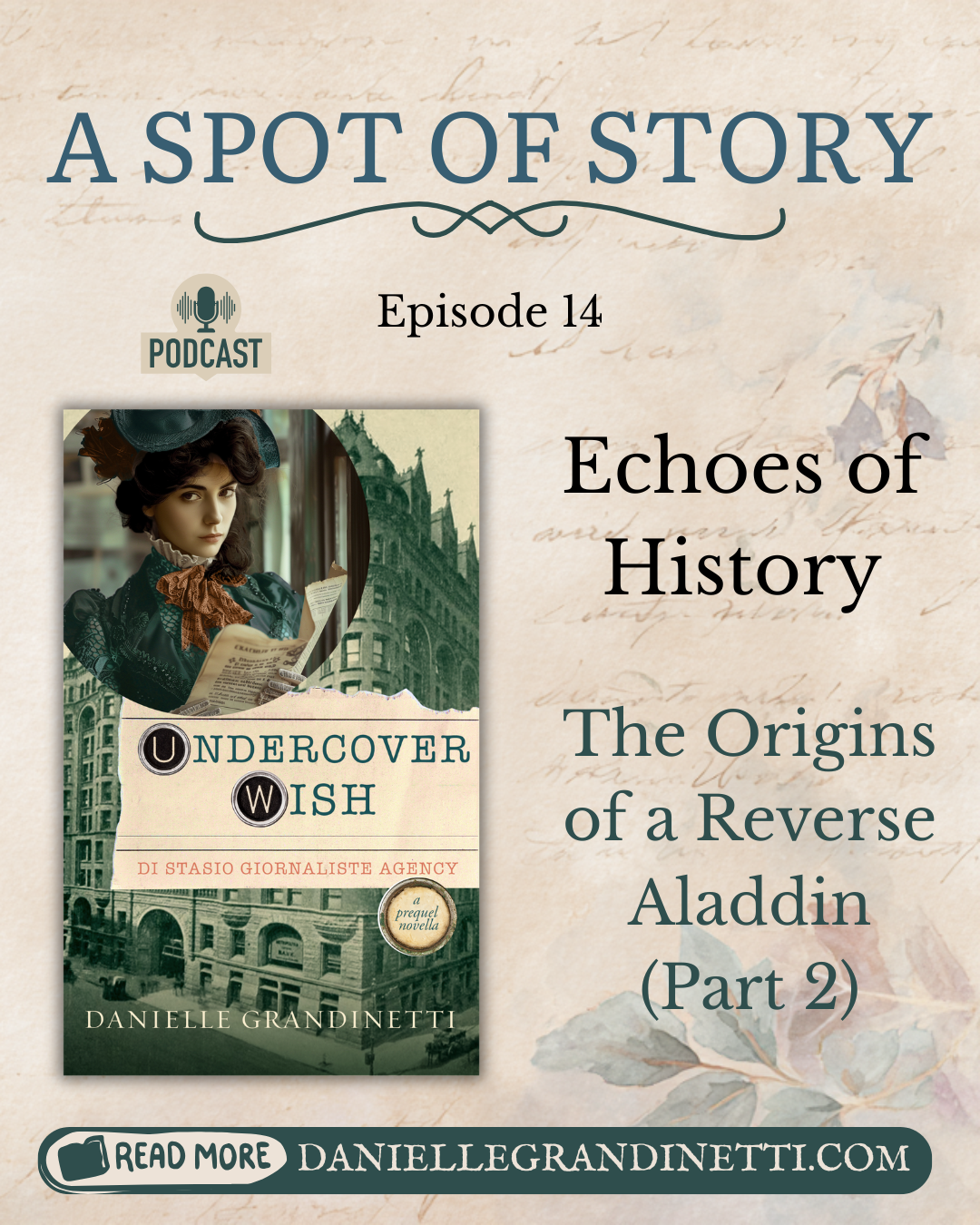
A Spot of Story Episode 14 | Echoes of History: The Origins of a Reverse Aladdin (Part 2)
A Spot of Story Episode 14 | Echoes of History: The Origins of a Reverse Aladdin (Part 2)
The Origins of a Reverse Aladdin (Part 2)
Episode 14
Listen In
Below, you’ll find the full transcript of today’s episode, in case you prefer to read or want to reference something we talked about.
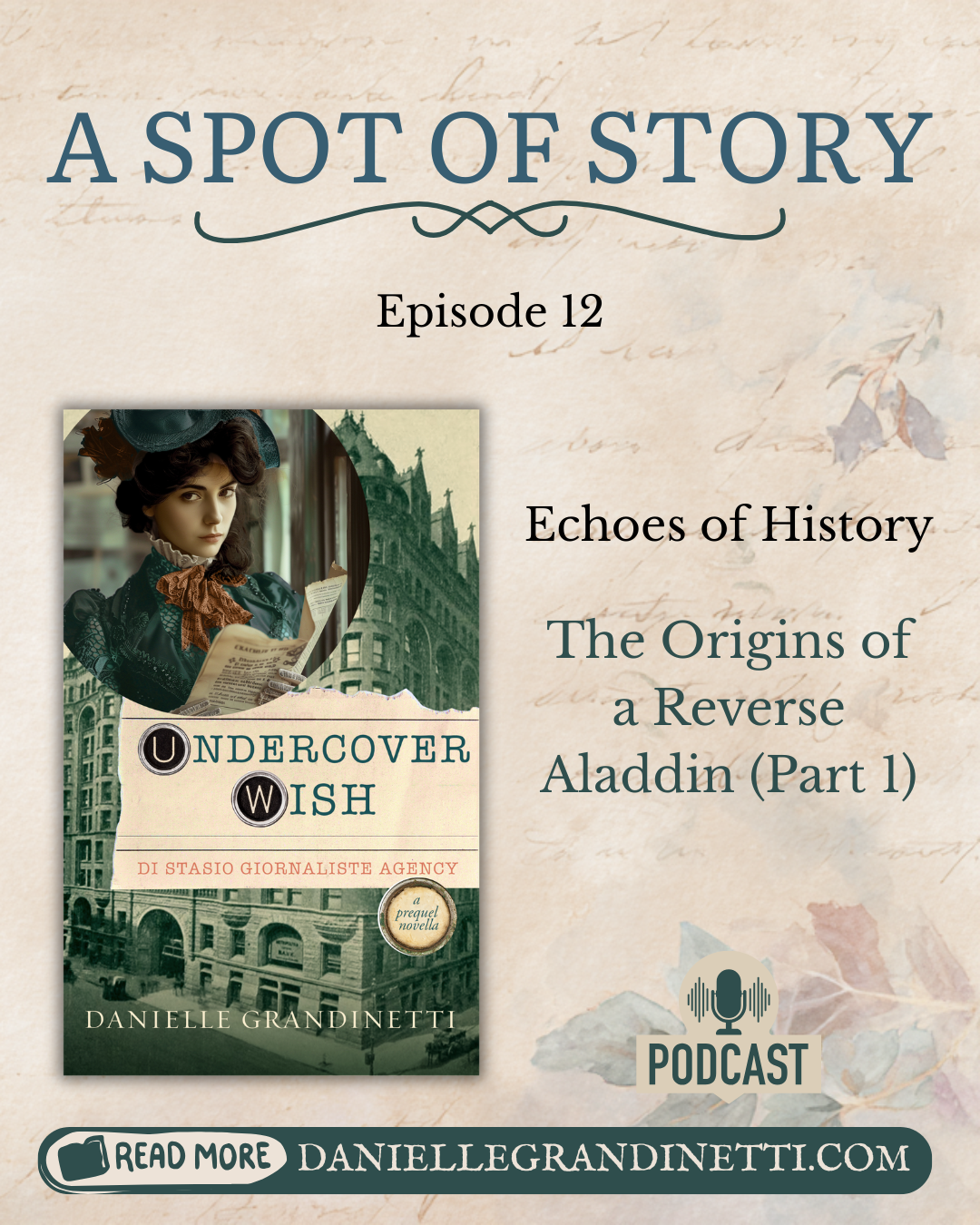
About Undercover Wish

Wealth is but an illusion, hers to wield and his to escape.
CHICAGO, Ill., 1892—Stunt reporter Ali Di Stasio will risk anything to expose the truth and protect her fellow orphans, including rummaging through trash bins and putting herself in the crosshairs of the dangerous elite. After living on the streets, she knows every corner of her city, which means she can stay one step ahead of the cops, the powerful men who’d love to silence her before she can reveal their secrets, and the occasional wealthy bachelor wandering through her alleyways, lost and in danger of being mugged.
Griff Moorland, heir-apparent to his father’s shipping enterprise, is summoned home to Chicago’s wealthiest neighborhood for one purpose: marriage. Worse, his choices are to marry the conniving daughter of his father’s business partner or an heiress with a sizable dowry. If he doesn’t comply before the contract to bring in steel for the Columbian Exposition ends? His ailing mother will be stranded across an ocean, homeless.
Caught between keeping his mother alive and his father’s questionable business practices, Griff needs a way out of the bind his father has put him in. When Ali swoops in like a knight in shining armor, she insists the pen is mightier than a sword. But with the Chicago World’s Fair fast approaching, sinister forces conspire against them. Will love prove only a mirage, or will it be strong enough to set them free?
La Verità con Integrità. Truth with Integrity. The Legacy of a (Girl) Stunt Reporter.
A Di Stasio Giornaliste Agency origin story and a retelling of Aladdin and the Magic Lamp.
About Danielle Grandinetti
Danielle Grandinetti writes award-winning 1930s historical romance filled with mystery, suspense, and hope. She is a second-generation Italian-American rooted in Midwest traditions. Fueled by tea, books, and the creative beauty of nature, her stories explore love and belonging in hard times.
Want to Read it Today?
*as an Amazon Affiliate, I earn from qualifying purchases.
Transcript
Danielle Grandinetti: On this episode of A Spot of Story: Echoes of History, we’re stepping back into our topic from last month, talking about Undercover Wish and how it is a retelling of Aladdin and the Magic Lamp. The original story of Aladdin and the Magic Lamp was written prior to the 1700s. This is an old story, and the stereotypes it leaned into were negative toward Chinese people. Aladdin was originally Chinese, and they portrayed him as lazy and opportunistic.
Even the way he got the princess—who was not named Jasmine in the original—to marry him was very underhanded. It did not paint Aladdin in a good light. This idea that he was a “hidden gem” or a “diamond in the rough” was not the original story at all; that was an attempt at redeeming the story later on.
I had to ask: How do I take this story that is so negative toward an entire group of people and use it to create my own story? I realized that with Ali, I could create that in her situation. People saw her as a criminal. In the opening scene, she is running from the police because she was trying to uncover a crime—not because of what she was doing, but because of who she was.
This is prior to the legislation that came about in the sixties where you could not be arrested for who you are—for example, for being homeless, a drug addict, or a prostitute. Back then, you had to be arrested based on something you did. Because Ali comes across as homeless, which she actually was as an orphan, the cops went after her.
Her sense of justice is what really drives the story. That is the choice I made that actually deviates from the prejudice stereotype of the original story. I don’t think an entire group of people should be labeled something just because of somebody else’s prejudice. I wanted to show that happening to Ali—that she was being prejudiced against because of who she was.
If that’s Ali, then who is my princess character? In a reverse Aladdin perspective, I decided to make him a shipping prince in Chicago. There was a section of town called Astor Street, named after the Astors in New York. My hero, Griff Moorland, has agency and yet he doesn’t.
Diving into his story involves this concept of how someone who has it all—wealth, male privilege, power dynamics in his court—can feel completely trapped. He’s being pigeonholed and coerced into a gilded cage. Of course, the late 1800s is called the Gilded Age. To pair that type of character with an Aladdin character was so much fun—to have those opposite dynamics where Ali was actually freer than the man with all the power, who felt caged by his situation.
The other aspect of the Aladdin and the Magic Lamp story that is different than the common version is that there’s not just one genie; there are two. And it’s not just a lamp; there’s also a ring. My story is historical and not magic at all, so I had to adapt.
I needed two “genie” characters and I had so much fun creating them. You have to read the story to get the full dynamic; I don’t want to give that away. I also wanted them to represent what Jane Addams did—the idea of using their status and situation to help others. It was so much fun to weave them into the story.
Regarding the two items, the lamp versus the ring, I wanted to create two different items that Griff and Ali were after. This explains why she was digging in the trash can at the very beginning of the story, leading to the uncovering of the corruption that has Griff trapped and showing how the truth matters in the end.
The essence of the story is that truth without integrity still doesn’t get you anywhere. You have to meld the two together. That is the entire theme behind why Ali then created the Di Stasio Giornaliste Agency. The journey of these two through the story opened the way for the agency and the rest of the series coming your way.
I’m so glad I got the opportunity to dive into the original story of Aladdin and the Magic Lamp. As heartbreaking as it was to read because of the stereotypes, I hope my story shines a light on how easy it is to fall into prejudice and what we can do to help others. I hope others can see themselves in the story, too.
There’s so much of the story that I hope offers hope—a sense of found family and belonging. No matter your background, race, or gender, you are still welcomed, loved, and unique. You belong in this world and deserve to be celebrated. I hope that becomes a wish come true for you.
Thank you for joining me on Echoes of History today. You can find additional resources and show notes on the episode page.
Share the Tea
Enjoyed today’s post? You can share it with a friend, pin it to your reading list on Pinterest, or pass it along in your favorite book group. You’re welcome to use this graphic or one of the share buttons below.
I’d love to hear what resonated with you about this book — feel free to leave a comment. I always reply, though if it’s your first time posting I’ll need to approve it before it appears.
And if you’d like to support me and help keep it free, you can always buy me a tea.
Ciao, and thanks for visiting!
The best way to stay connected is through my weekly email, Fireside News. You’ll receive cozy updates, behind-the-scenes book notes, and a complimentary historical romance novelette when you subscribe.
Until next time, may your reading bring both light and encouragement.
Happy reading!
~ Danielle.